The artworks are listed in order, starting from the corner of Cheltenham Cemetery at Port Road and High Street, to enable you to do a self-guided walk.
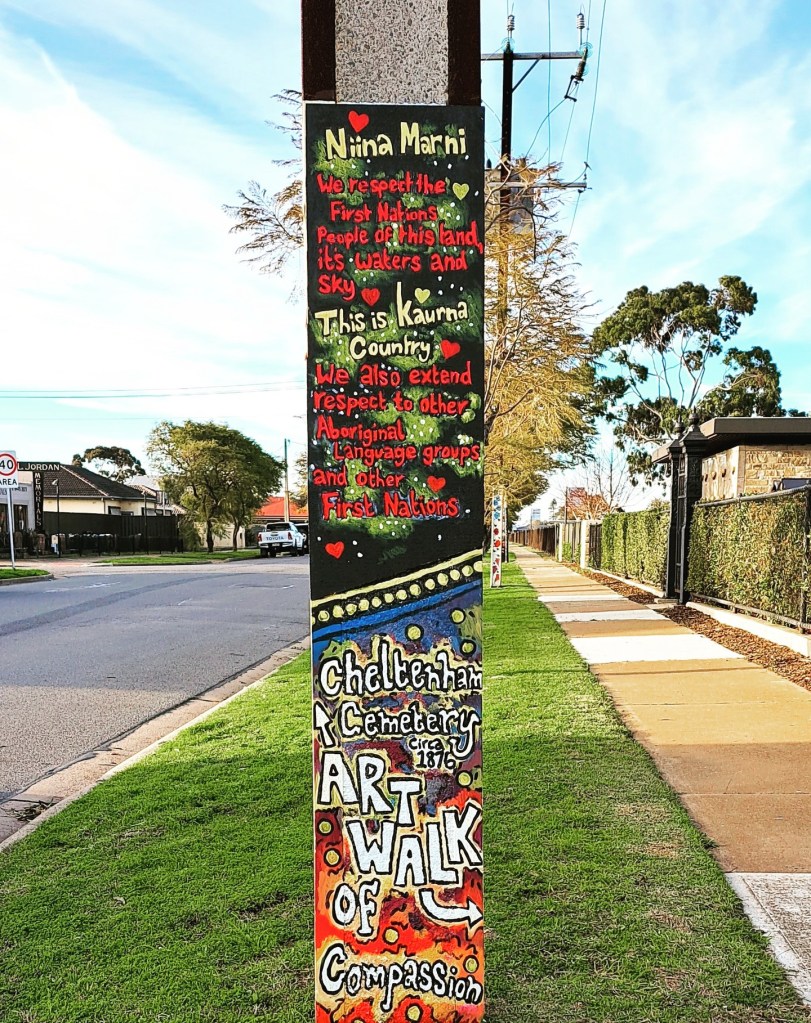
1. Cheltenham Cemetery Art Walk of Compassion by Chloe Bower
Pole Location: Cnr Port Rd & High St, south facing.
This pole welcomes everyone to the project and recognises the traditional Kaurna custodians of the land the cemetery resides on.
2. Tranquility Corner by Leanne Shearing
Pole Location: Cnr Port Rd & High St, north facing
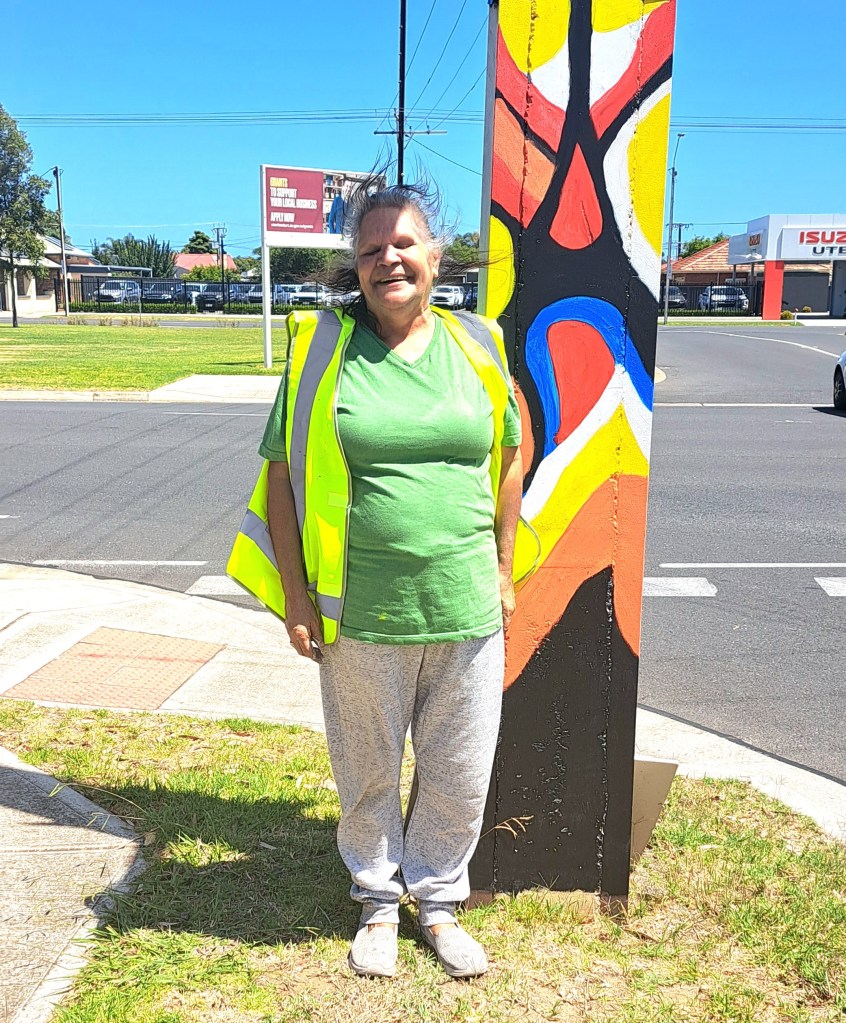
Painted using Leanne’s signature abstract style, using colours she feels remind her of tranquility.
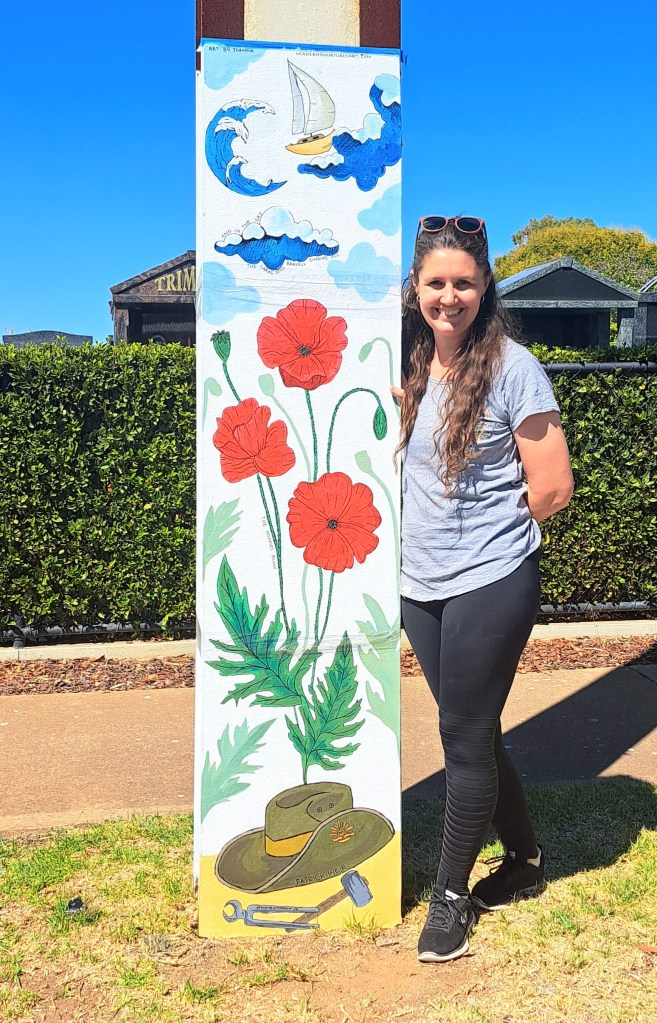
3. Captain Patrick Weir by Joanna Hubbard
Pole Location: High St, south of Cemetery Drive A, west facing.
Joanna chose to paint a tribute to service people and the lives lost in war, in Patrick’s honour.
1855- born in Scotland, Died 1932 at Semaphore
1870 – Went to Sea aged 15, on the Craigendarroch
1879 – Mate on the Monalite, which he left at Port Adelaide to be Second Officer, and later Captain, on the Governor Musgrave.
He owned the tug Ariel and the steamer Argyll
1900-01 Lieutenant on the Protector in the Boxer Rebellion
1915 – sent to Cocos Island to see if the German cruiser Emden could be salvaged. Also appointed Port Adelaide Harbour Master.
1925 – retired.
Grave Location: Section D. Drive B. Path 14. Site 14.
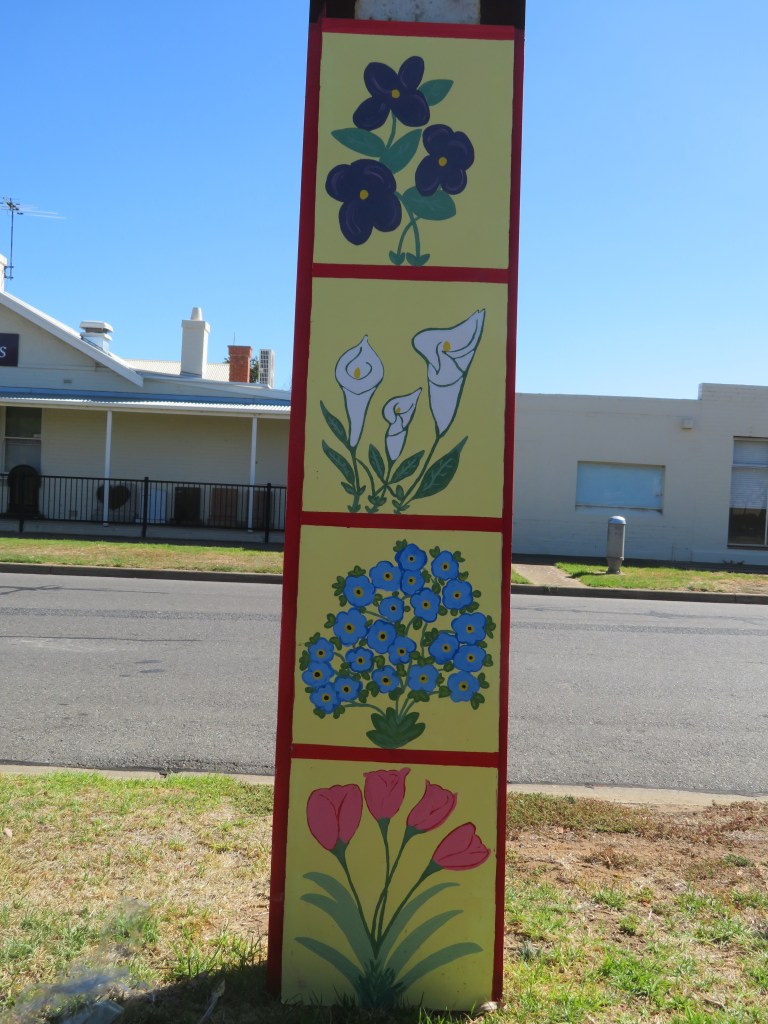
4. Floral sentiments and symbolism by Stella Hayes
Pole Location: High St, south of Cemetery Drive A, east facing.
Stella, has depicted a variety of flowers that offer sentiment to the deceased at the cemetery, and their families.
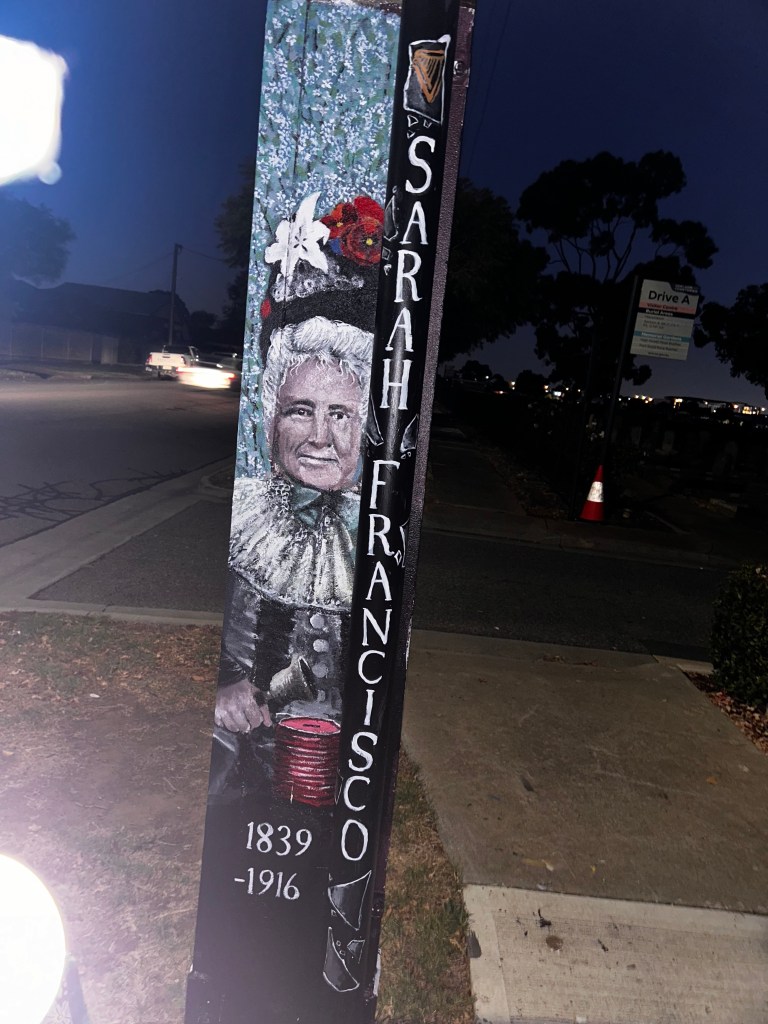
5. Sarah Francisco by Emelia Mazzoleni
Pole Location: Cnr High St and Cemetery Drive A, south facing.
- 1839 – Born in Ireland, Died 2 Nov 1916.
- 1860s – Arrived in SA. Later married and had two sons.
- Survivor of domestic violence. Husband once tried to throw her down a well, several times tried to poison her. Struck her in the face with a brass candlestick, which scarred her across the mouth. Eventually he abandoned her.
- To survive, and provide for her sons, Sarah cleaned hotels and took any job she could, often leaving home at 3am carrying one child in her arms, the other on her back, and working until 11pm.
- Death of her youngest child resulted in her downward spiral.
- 1872 – first conviction. Became a notorious Adelaide Gaol inmate with 295 convictions for drunkenness, indecent/abusive language, assault, resisting police, riotous behaviour, & disturbing the peace, mostly in Port Adelaide.
- Spent a total of 16 years in jail, including 12 Christmases. Most of her short sentences were served concurrently. If she had served her full terms of imprisonment, she would have spent more than 180 years in prison!
- She even had her own cell in Adelaide Gaol’s No. 2 yard, which was vacated by the current occupant whenever Sarah was brought in.
- Given her drunken behaviour, she was placed under the then Aborigines Act, which made selling alcohol to her a punishable offence.
- Later in life, she sobered up, and joined The Salvation Army. She used her notoriety to secure donations from her familiar watering holes and no publican dared refuse.
- The shape of her headstone is the same as the Salvation Army Shield.
Grave Location: Section M. Drive C. Path 30. Site 302 S.
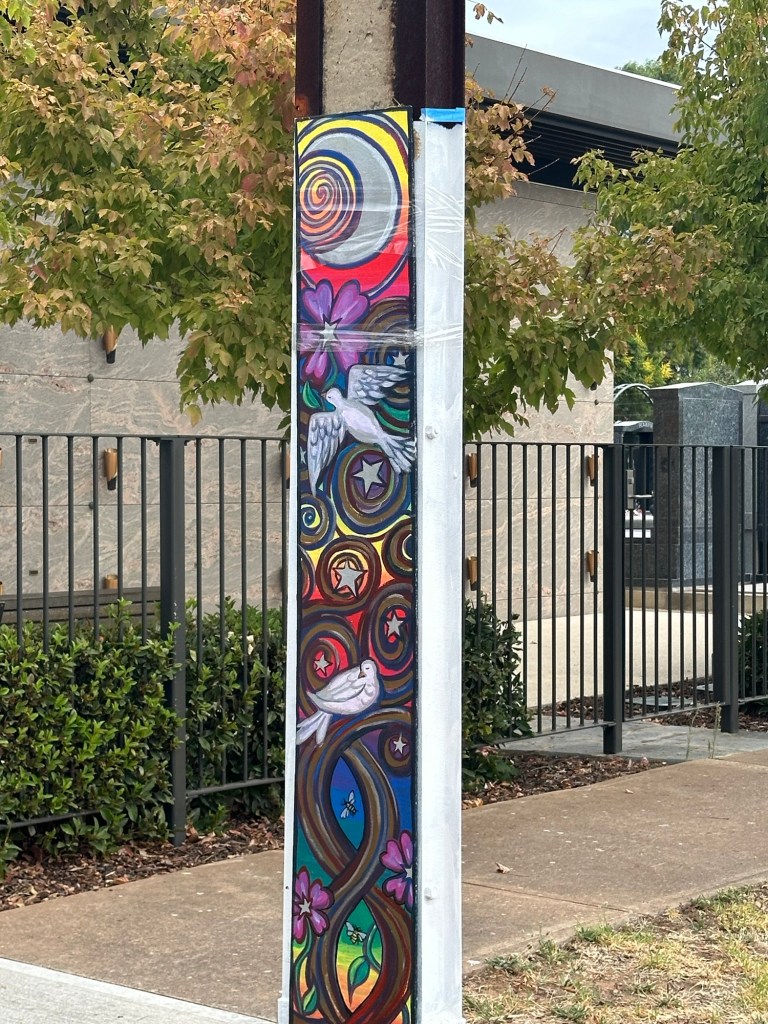
6. Tree and peace doves by Penny Mortimer
Pole Location: Cnr High St and Cemetery Drive A, north facing.
Using bright colours, Penny conveys a winding tree under a bright night sky, with peace doves.
The tree references the large trees that line the cemetery avenues.
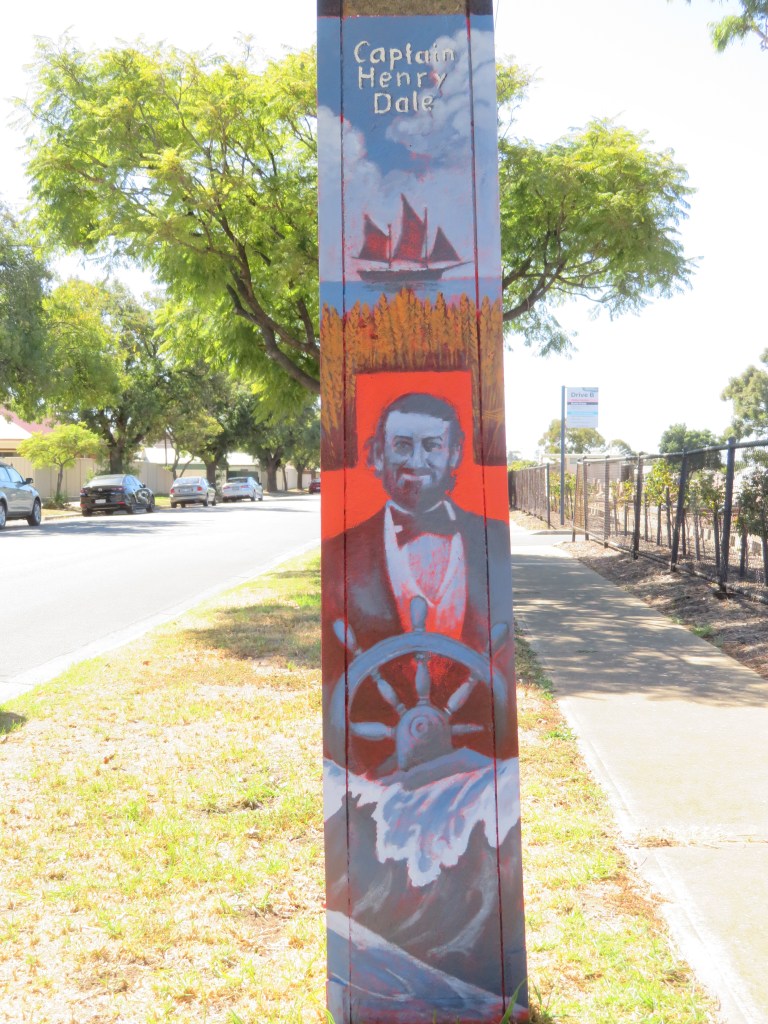
7. Captain Henry Dale by Ricardo Gomez
Pole Location: High St, north of Cemetery Drive A, south facing.
- 1821 – born in England, died 1913.
- One of the most prominent men of his time in Port Adelaide.
- 1835 – Joined the famous Dunbar Line of convict & trading ships, aged 14.
- 1838 – First voyage was to Sydney on the Earl Grey, carrying 290 convicts.
- Became Master of the ship, Hero, which carried many gold seekers to and from goldfields. Sailed between Adelaide, Launceston, Melbourne and Mauritius.
- 1854 – settled in Port Adelaide after 20+ years at sea.
- Ran a general merchants business from the Queens Wharf and Stores with business partner G. H. Fox.
- Dale street in Port Adelaide is named after him.
- 1871 – Set up and named Port Broughton.
- Served on Woodville Council for 25 years until 1907.
Grave location: Unknown
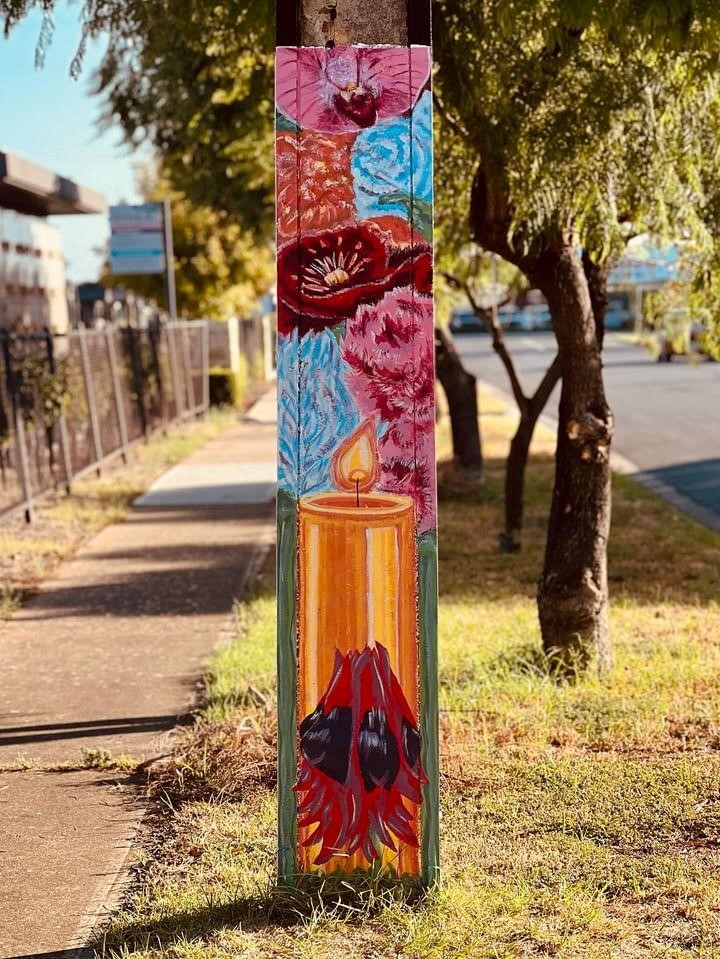
8. Graveyard symbolism by Andie McGovern
Pole Location: High St, north of Cemetery Drive A, north facing.
Andie made this work thinking of the sentiments of flowers, and the feelings of visitors to the cemetery.
She has considered different nationalities and cultural backgrounds, and has included the local Sturt Desert Pea as she thinks of the lives of the families of First Nations Peoples.
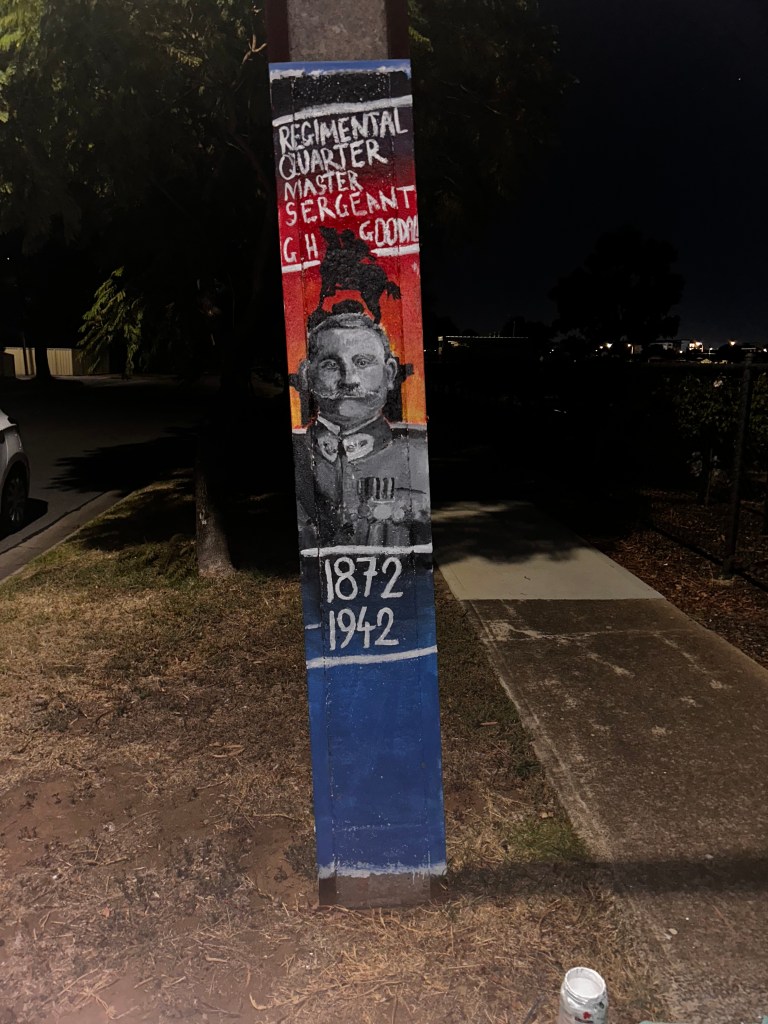
9. George Henry Goodall by Emelia Mazzoleni
Pole Location: High St, north of Cemetery Drive B.
- Born 16 March 1872, Died 30 July 1942.
- A descendant of pioneers who arrived in 1839.
- A blacksmith and farrier by trade, he had an ability to break and ride any horse.
- Served 8 years in the South Australian Garrison Artillery, becoming a Non Commissioned Officer with a gun layers badge.
- Joined the Mounted Rifle in 1898.
- Became Regimental Quarter Master Sergeant
- Sat as the model for Adelaide’s bronze Boer War Memorial statue, located on corner of North Terrace and King William St.
Grave location: Section C, Drive A. Path 15, Site 108A
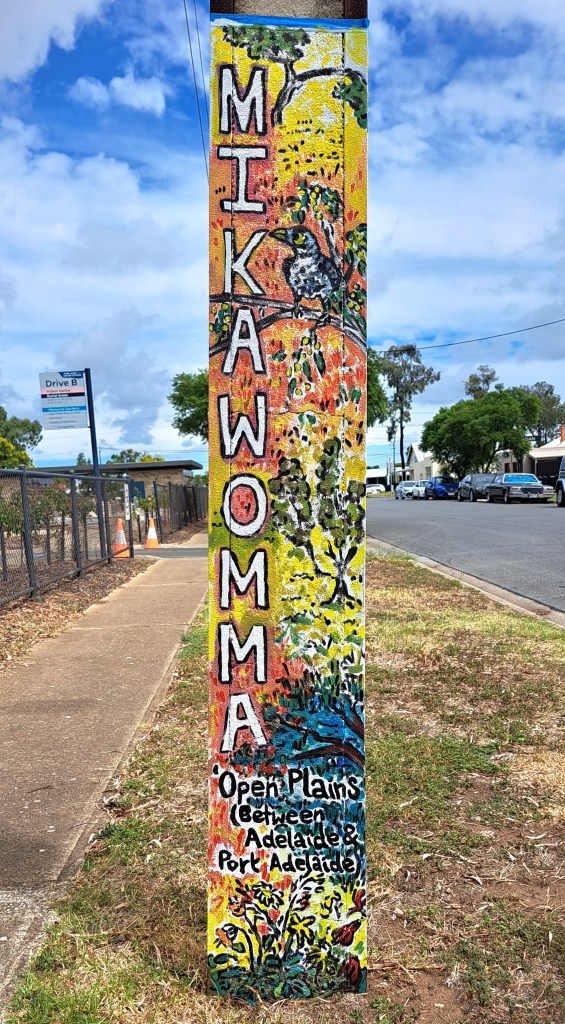
10. Mikawomma Plains by Chloe Bower
Pole Location: High St, north of Cemetery Drive B.
This work pays tribute to the land the Cheltenham Cemetery resides on, and what it may have looked like before the influence of colonization.
The land was flat, with native pine groves, meadows and vegetation. Native animals who lived there were hunted for food by local Kaurna people.
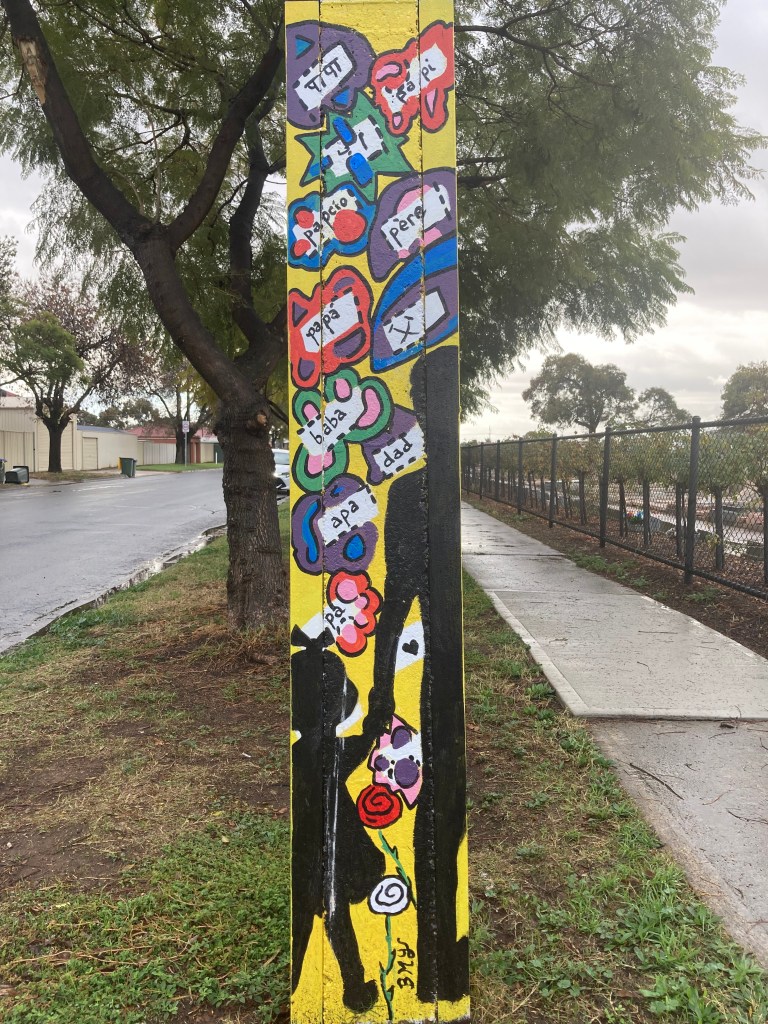
11. Father’s Day flowers by Beiha Yanez
Pole Location: High St, near toilet block between Cemetery Drives B and C, south facing.
Beiha, as a new mother herself, has made this work thinking of the fathers of different cultural languages and backgrounds buried at the cemetery.
It features an arrangement of the word DAD in different languages.
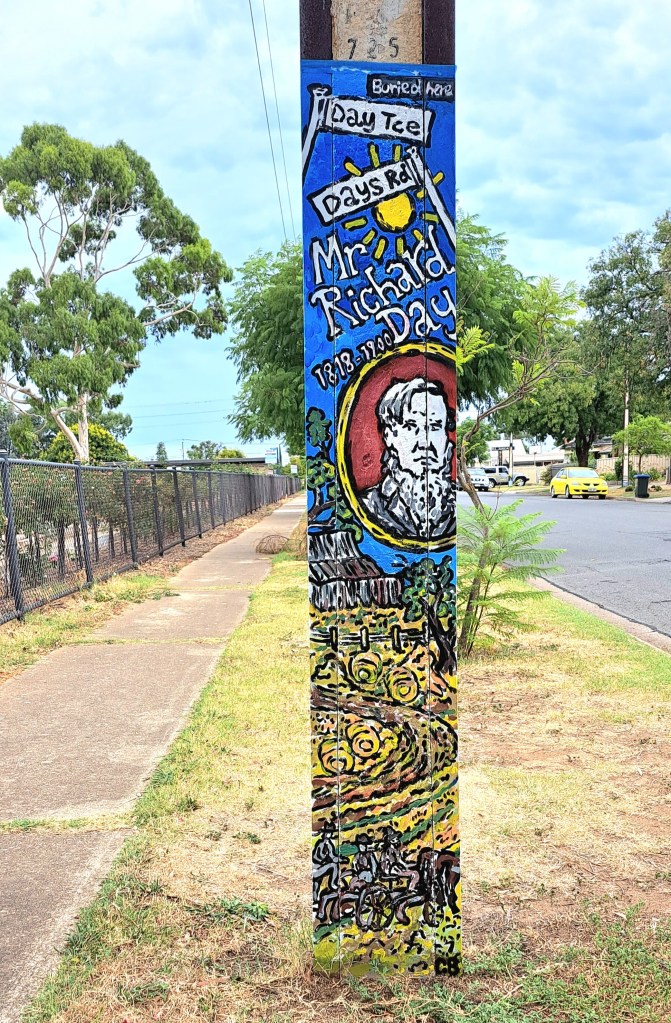
12. Richard Day by Chloe Bower
Pole Location: High St, near toilet block between Cemetery Drives B and C, north facing.
- Born 1818, died 31 March, 1900
- 1838 – Arrived in South Australia, with wife Mary Ann, two years after its establishment, with less than £1 to their name. Their son, Thomas, born the day after arriving in SA, aboard the vessel ‘Royal Admiral’, died at age 11 months and was buried at West Terrace Cemetery.
- By astute land investment, farming, and hard work, he experienced business success.
- 1849, August – he bought all of Section 402, being 80 acres, for £160 from Richard Frew (of Frewville fame) and George Morphett (of Morphettville fame). This land was where the present Angle Park Greyhound Racing Track is situated, on the western side of Days Road. His land extended on both the west and east sides of Days Road and included the present Harold Tyler Reserve and the golf course at Regency Park. Richard was farming Section 419 and dairying at the home farm. The Cheltenham land fronted Port Road and is partly occupied since 1876 by the Cheltenham Cemetery, where Richard and Mary are buried.
- Two streets are named after him, Days Road and Days Tce
- Richard’s family timeline
His very large grave site is also the resting place of his wife, Mary.
Grave site Location: Section C Drive: A Path : 5(16) Site Number: 152N
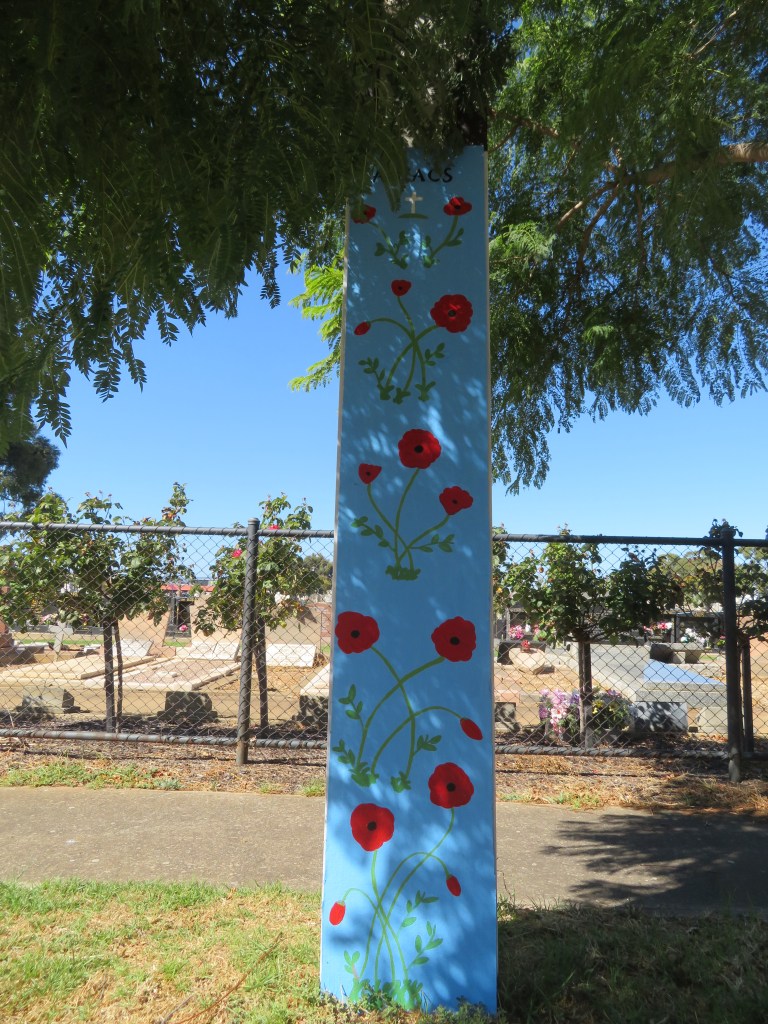
13. Poppies by Stella Hayes
Pole Location: High St, south of Cemetery Drive C, west facing.
This artwork pays tribute to the many graves at the cemetery whose occupants’ lives were lost in war.
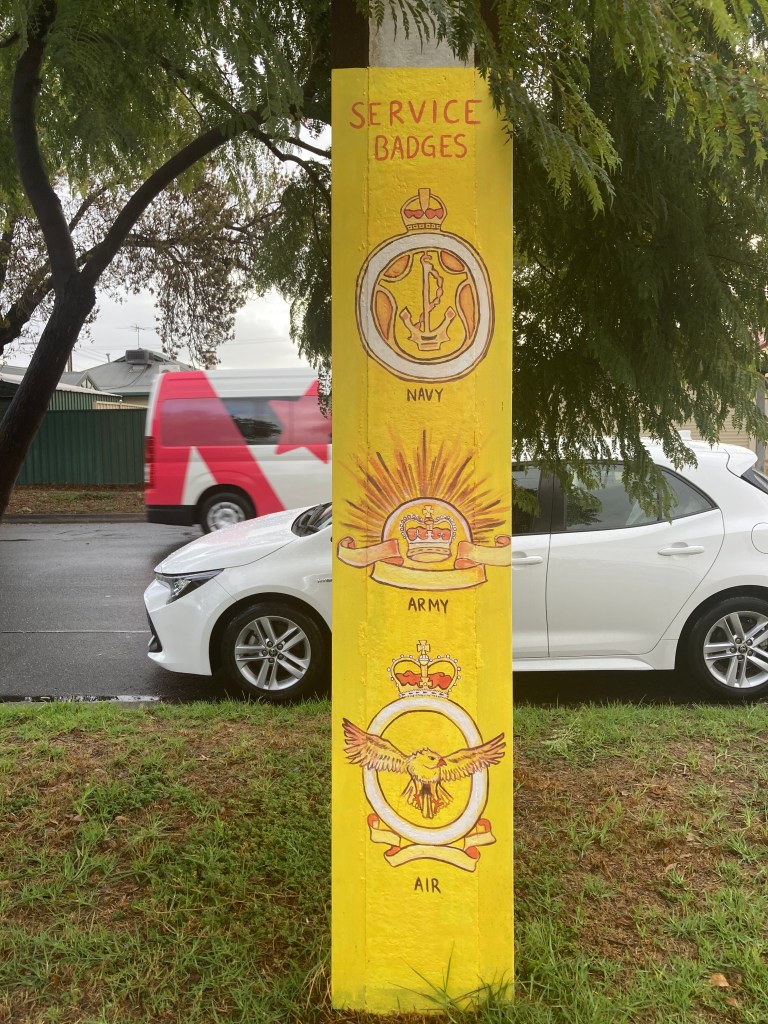
14. Service Badges by Shani Englebrecht
Pole Location: High St, south of Cemetery Drive C, east facing.
Commemorating those buried at the cemetery who spent their life in the armed services.
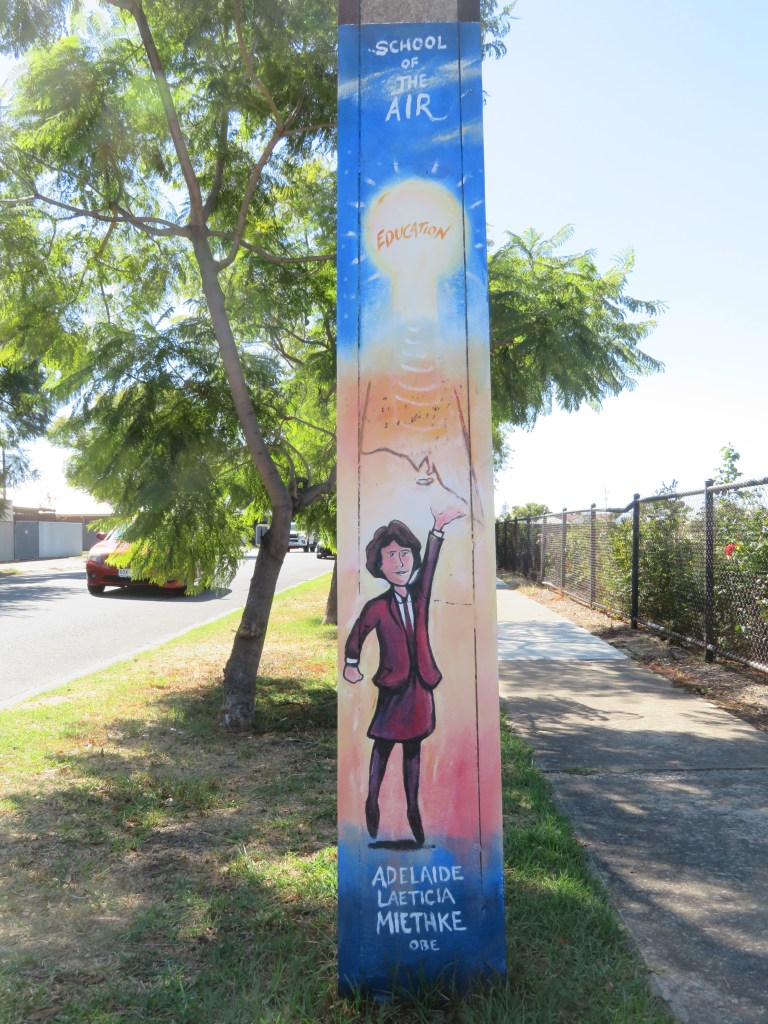
15. Adelaide Laeticia Miethke by Simon Kneebone
Pole Location: High St, north of Cemetery Drive C, south facing.
- Born 8th June 1881, Died 1962
- A gifted teacher who began training in 1899
- Active in women teachers’ and union affairs
- Spoke against the plight of new teachers being faced with class sizes of 60 – 70 students!
- First female inspector of high schools
- Worked with Royal Flying Doctor Service
- Conceived and established 1st School of the Air in Alice Springs in 1950
- The Adelaide Miethke Kindergarten opened in 1953, was named in her honour.
- Woodville High School has a room named after her.
- Adelaide died at her home in Woodville in 1962.
Original grave location: Section D. Drive B. Path 13. Site 54
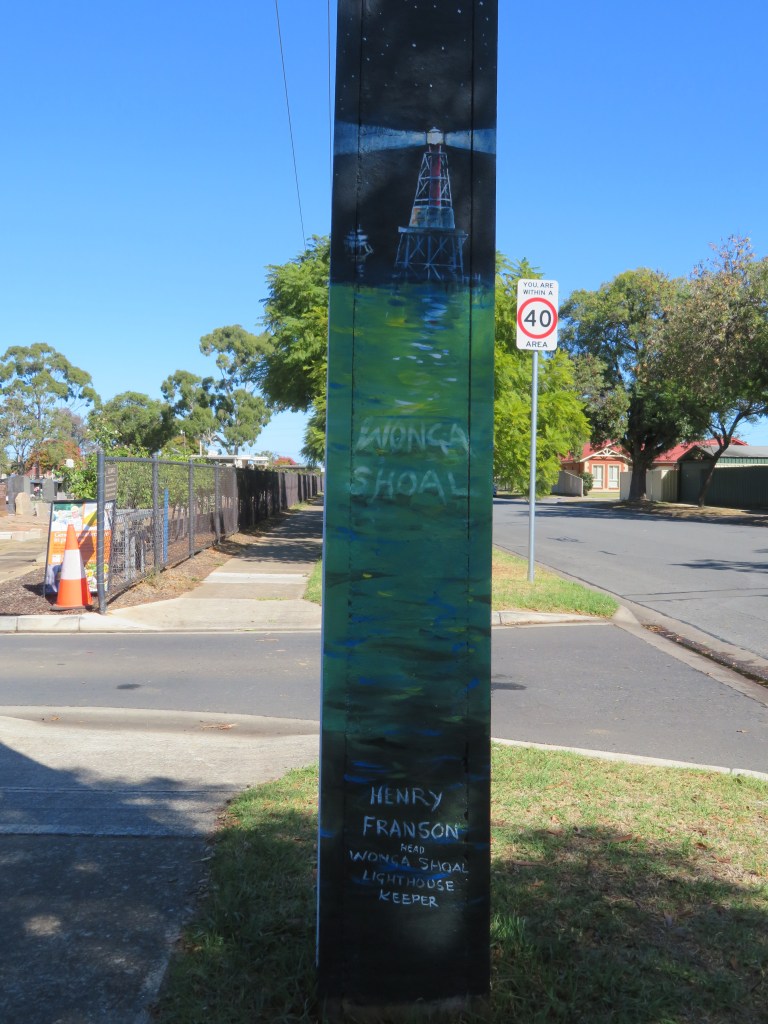
16. Henry Franson and Wonga Shoal by Simon Kneebone
Pole Location: High St, north of Cemetery Drive C, north facing.
- Henry Franson was one of two lighthouse keepers who drowned in The Wonga Shoal lighthouse accident. The other keeper was Charles McGowan.
- Wonga is an aboriginal word meaning sunset or west.
- Wonga Shoal Lighthouse stood at Semaphore, 2.8km off the Semaphore jetty. First lit on 1 July 1901, it incorporated the lantern and machinery from the old Port Adelaide Lighthouse, which it replaced.
- Early morning of November 17, 1912, the British ship Dimsdale ran into, and knocked over, the lighthouse.
- Ship Captain, John Jones, was found guilty of negligence but not manslaughter. His licence was suspended for 12 months.
Grave location: Section L. Drive C. Path 17.
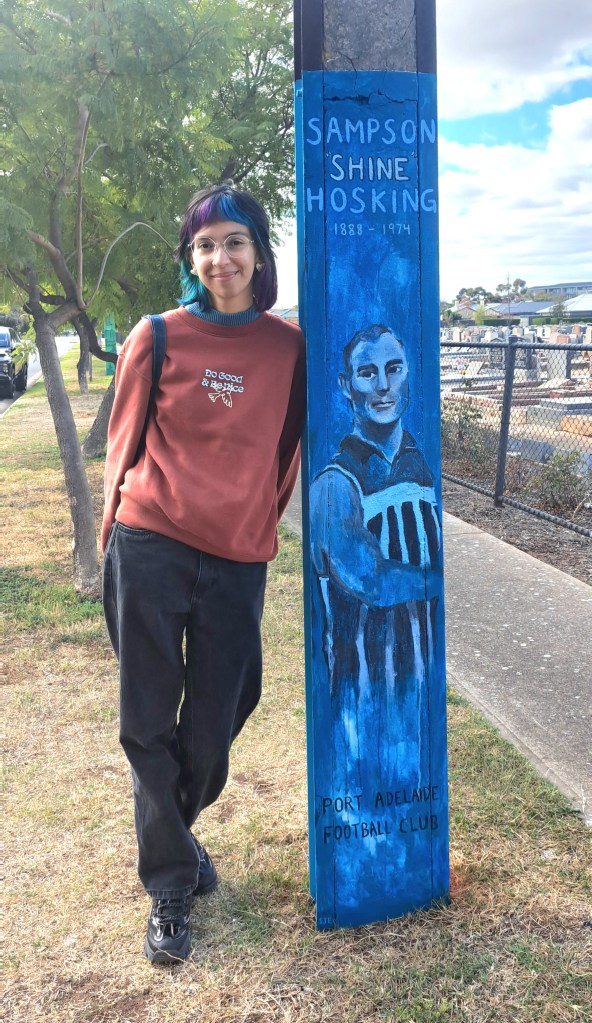
17. Sampson Hosking by Shani Englebrecht
Pole Location: High St, north of Cemetery Drive C, south facing.
- Born 4 Jan 1888, Died 20 Oct 1974
- Australian rules footballer for Port Adelaide Football Club (SAFL)
- Played 163 games, kicked 41 goals for Port Adelaide, 1907–1936
- Member of Port Adelaide premiership teams, 1910, 1913, 1914, 1921.
- Retired in 1921 but coached the team to premierships in 1928, 1936, 1937.
- In 1927 as Ports coach, he played two games!
- Twice recipient of the Magarey Medal.
- coached both Port Adelaide, & West Torrens Football Clubs to a combined six premierships.
- As coach of Magpies in 1936 (aged 48) he sat on bench as 19th man for one game. He still holds the record for oldest player.
Grave location: Section E. Drive B. Path 31. Site 290 S
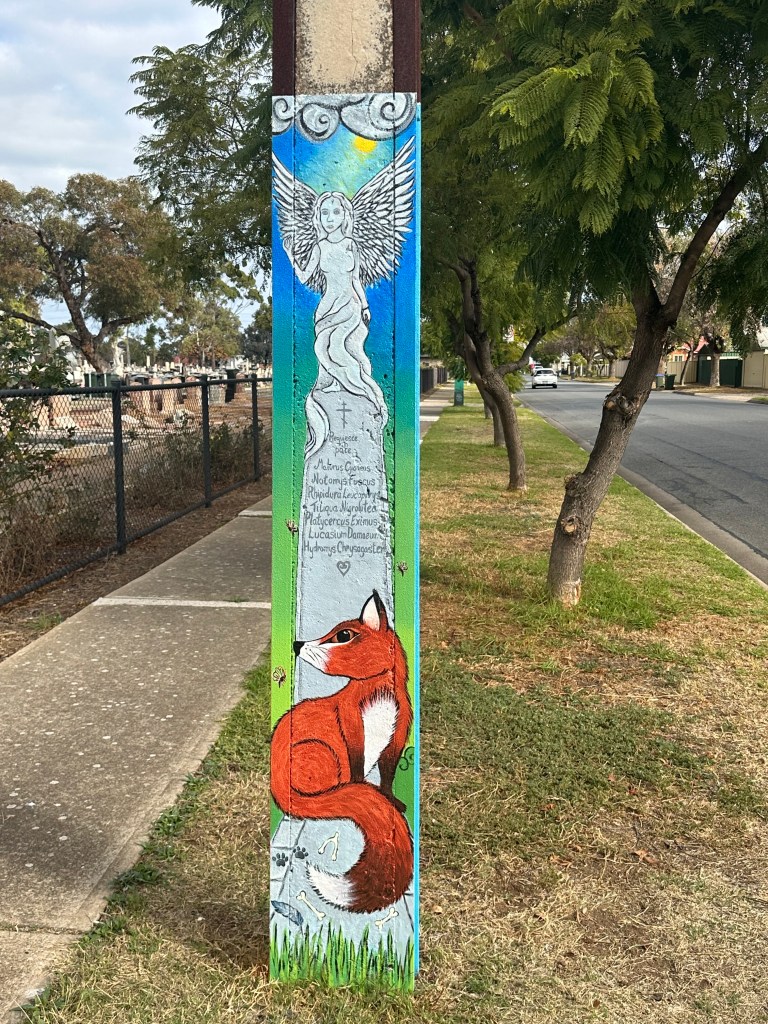
18. Angel and cemetery fox by Kat Coppock
Pole Location: High St, north of Cemetery Drive C, north facing.
- Kat made this work after hearing the story of a fox that is said to be seen living at the cemetery.
- She considered foxes’ impact on the environment and the population of the local bird life (note animal bones on grave site).
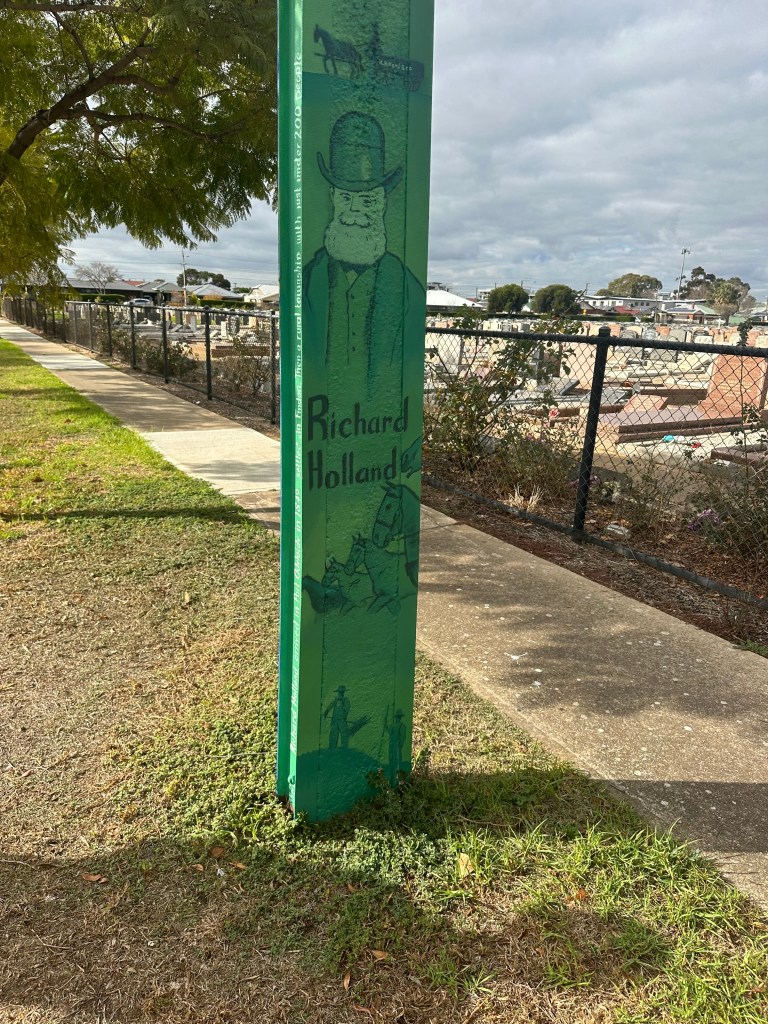
19. Richard Holland by Ricardo Gomez
Pole Location: High St, south of Cemetery Drive D, south facing.
- Born 27 August 1826, Died 18 August 1911
- Son of a convict, also named Richard Holland.
- Arrived at Pt Adelaide in 1849 and farmed at Findon. The area only had 200 people at the time and surrounded by Lucerne Groves, market gardens, dairies and poultry farms.
- He had 1000 acres and grew crops, bred pigs and operated a dairy.
- Formed his own company, R. Holland & Co, and worked up to owning carts, trolleys and more than 100 horses. He carted wood from the Port to timber mills in Adelaide.
- He and his family were hard workers. His 10 children helped, working from 7am until dark every day.
Grave location: Originally Section N. Drive C. Path 24. Site 49N. (Site now redeveloped)
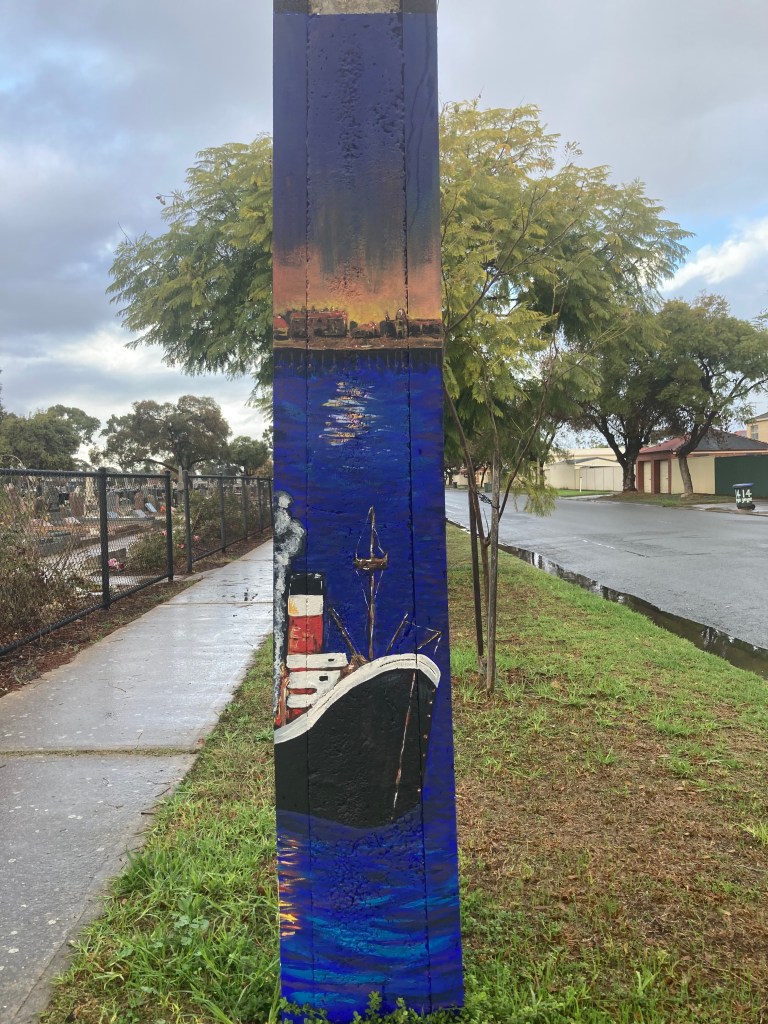
20. Pt Adelaide fire/brigade memorial by Tracey Davis
Pole Location: High St, south of Cemetery Drive D, north facing.
In this work, Tracey has depicted the scene of a burning ship in the harbour of Port Adelaide in 1924, when the ship The Singapore caught fire and lives were lost.
The SS City of Singapore arrived in Pt Adelaide 22nd April 1024, at dock 2.
It carried volatile and highly explosive cargo of petrol, kerosene and oil. Over two days, 22,000 cases of petrol were unloaded and 4,000 transferred to the holds.
26th April, smoke bellowed from the ventilators and the steamer ship was ablaze. The fire brigades responded quickly – Pt Adelaide, Semaphore brigades, and Wakefield St headquarters were called.
10:30pm the fire seemed under control. But, beneath them, heat from the fire had released gas and coal dust.
11pm – a dramatic explosion occurred. Four sheets of flame shot hundreds of feet into the air. Buildings in distant suburbs shook. Pieces of ship deck were blown into the air, through the wharf and the walls of adjacent sheds. Fire hoses were damaged and the road surface strewn in all directions. The pyrotechnics display continued throughout the night and most of the next day and fire brigades fought to keep the flames from reaching the remaining flammable cargo.
Three firemen were killed while putting out the fire: Albert Greenman, James Hickey, and George Anderson.
A monument to the lost firemen can be found in the cemetery at Section B. Drive A. Path 11. Site 326 S.
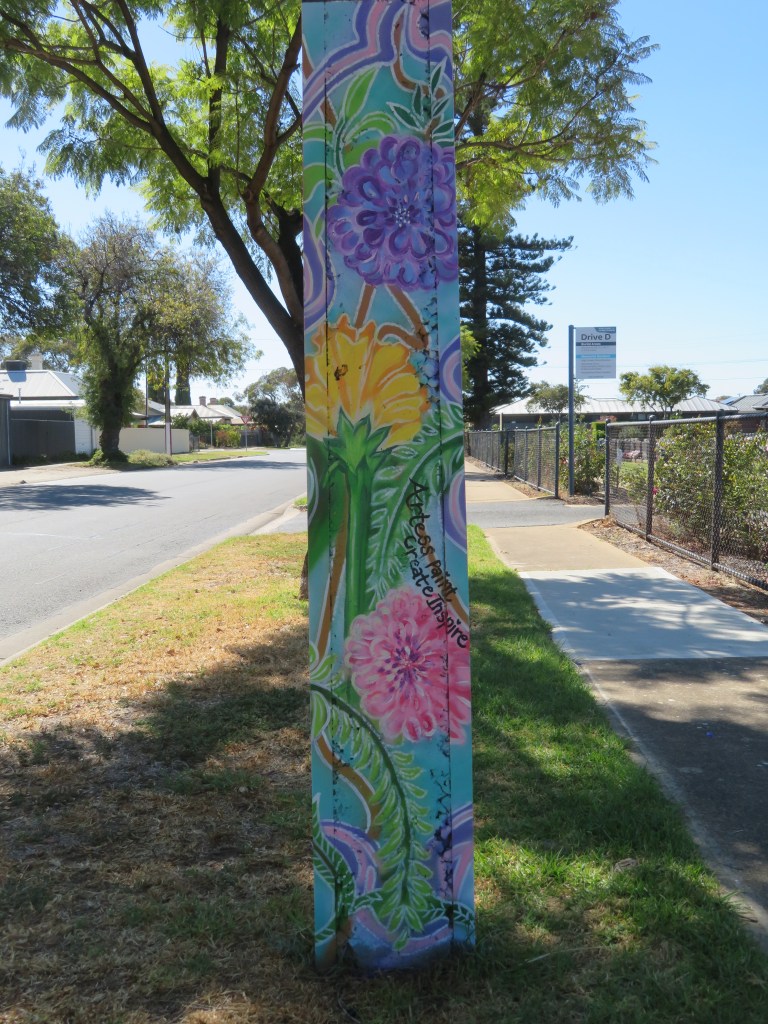
21. Floral tributes by Tessa Brown
Pole Location: High St, south of Cemetery Drive D, south facing.
A colourful tribute to the flowers that adorn the cemetery during the special time of Mother’s Day.
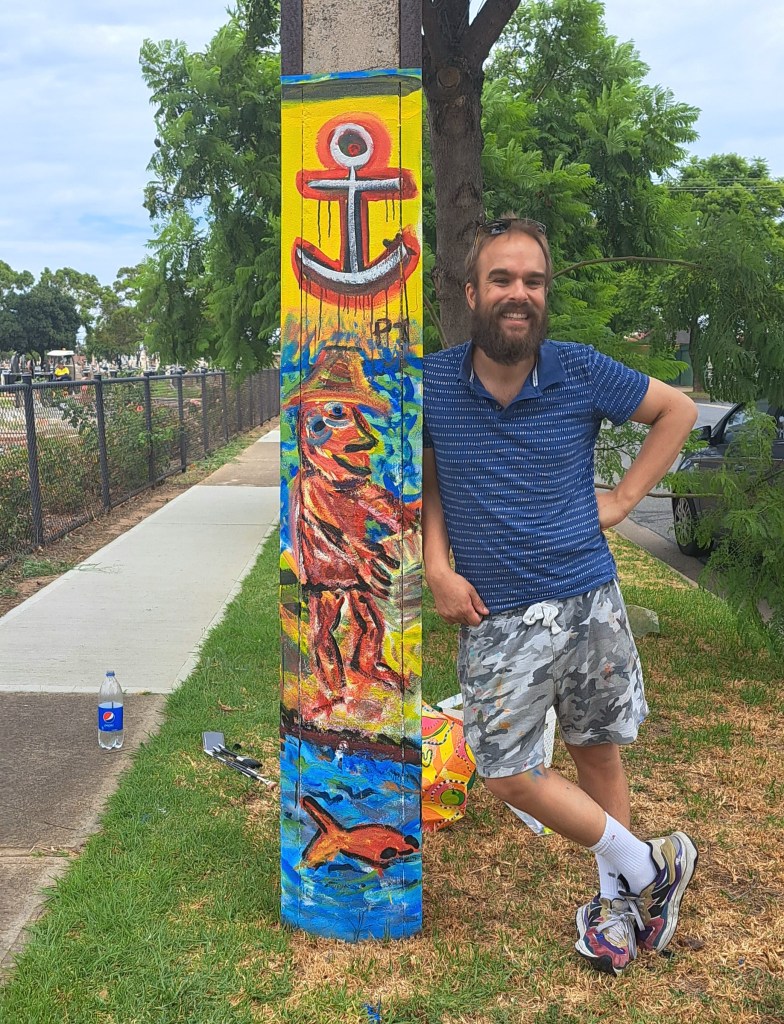
22. Merchant Seamen by Paul Thorsen
Pole Location: High St, south of Cemetery Drive D, north facing.
- In his signature anti-aesthetic style, Paul has used expressive brush strokes and bold colours to render his image of a seaman down by The Port, carrying his wares to be sold.
- This is a reference to the monument at the cemetery that commemorates merchant seamen who died in the waters of South Australia from 1942 to 1974 and buried at Cheltenham.
The monument is located near Drive D at Chippenham St end.
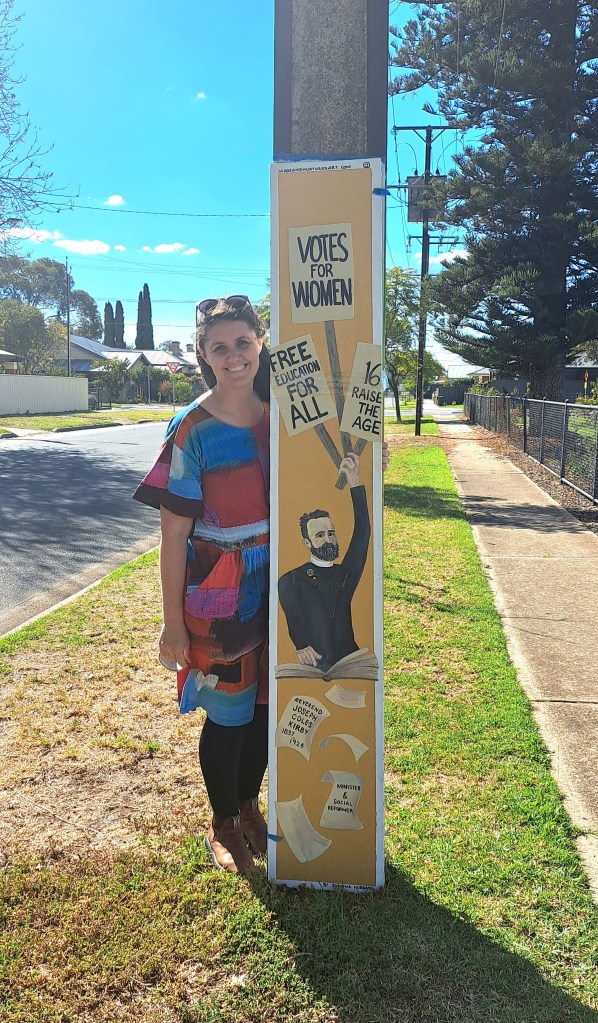
23. Rev. Joseph Coles Kirby by Joanna Hubbard
Pole Location: High St, north of Cemetery Drive D, south facing.
- Born 10 June 1837, Died 1908
- Congregational minister and social reformer.
- Born in Buckingham, England, son of John Kirby, flour-miller, and his wife Mary, née Coles.
- Educated at the Quaker boarding school in Sibford Ferris, near Banbury.
- Family emigrated to Sydney in 1854 after his father went bankrupt.
- 1864 Kirby ordained into ministry.
- Advocate for women’s rights, temperance & social reform.
- Succeeded in getting age of sexual consent for girls raised from 13 to 16 years, and regulating the legal age of people working in brothels.
- 1880 he resigned from his role in NSW and moved to Pt Adelaide where he continued to campaigns for reform.
- Successfully campaigned to have hotel bars close at 6pm (lasted from 1915 – 1967). His grave shows a clock face with hands at 6 o’clock.
- Pt Adelaide’s Port Dock Brewery Hotel “The Old Preacher” ale was made in his memory in 1986. (He successfully had the original hotel closed down in 1909, plus a third of all hotels in the Port!)
- His wife, Margaretta, was the first woman in Pt Adelaide to exercise the right to vote. They share the same burial plot.
Grave Location: Section H. Drive B. Path 38. Site 13.
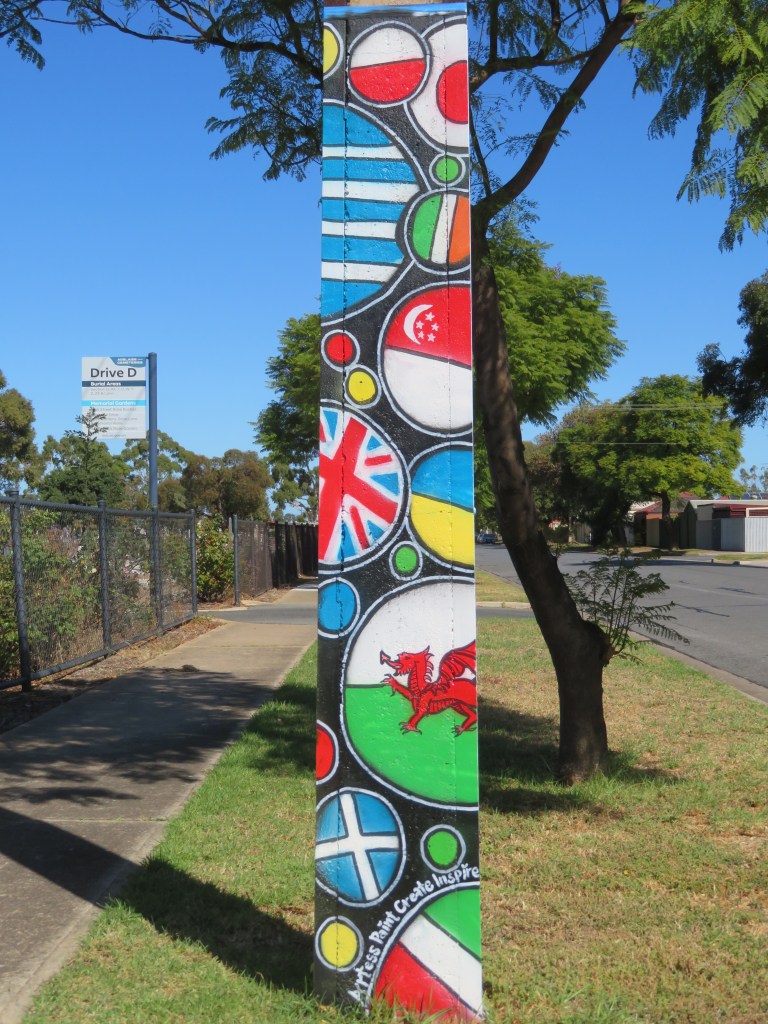
24. Nationalities by Tessa Brown
Pole Location: High St, north of Cemetery Drive D, north facing.
Tessa has created a colourful collage of flags depicting the range of nationalities represented within the Charles Sturt area, including those buried at the cemetery.
Many migrants moved here to work in the local factories eg: Holdens (employed 4,000 workers), Phillips, ACTIL, Simpsons (washing machine producer).
25. Live like ice-cream by Sambath Sathyan
Pole Location: High St, north of Cemetery Drive D, east facing.
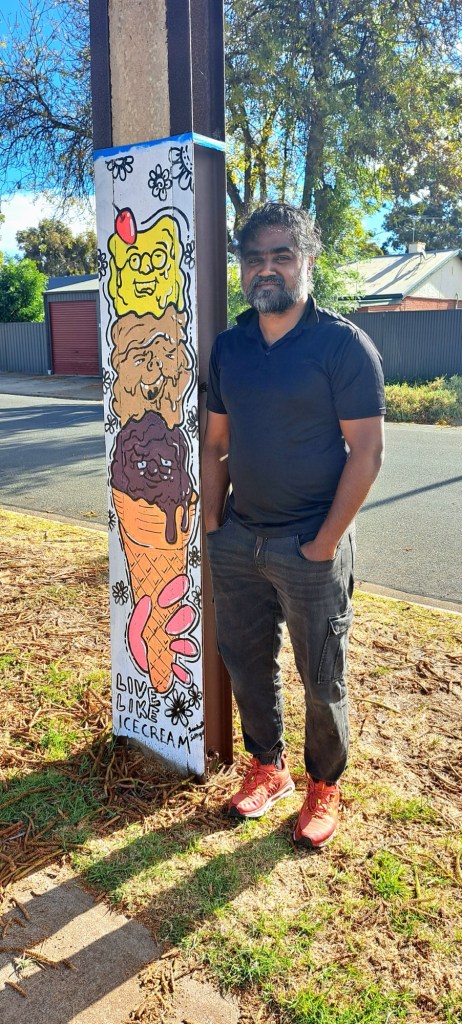
- Sambath wanted to paint something to help “lift the gloomy cemetery atmosphere”, especially for the little people who come with their grown-ups to pay respect to their loved ones. So, he drew something most children love – ice cream. The aging, happy faces on the ice cream convey the happiness and joy of a life well lived, and the happy memories they created.
- The title “Live Like Ice Cream” refers to the flowing (melting) nature of ice cream representing the flow of life, and the happy memories of past enjoyment of ice cream representing the happy memories of loved ones.
26. Hanna Mussared by Tracey Davis
Location: High St, north of Cemetery Drive D, West facing.
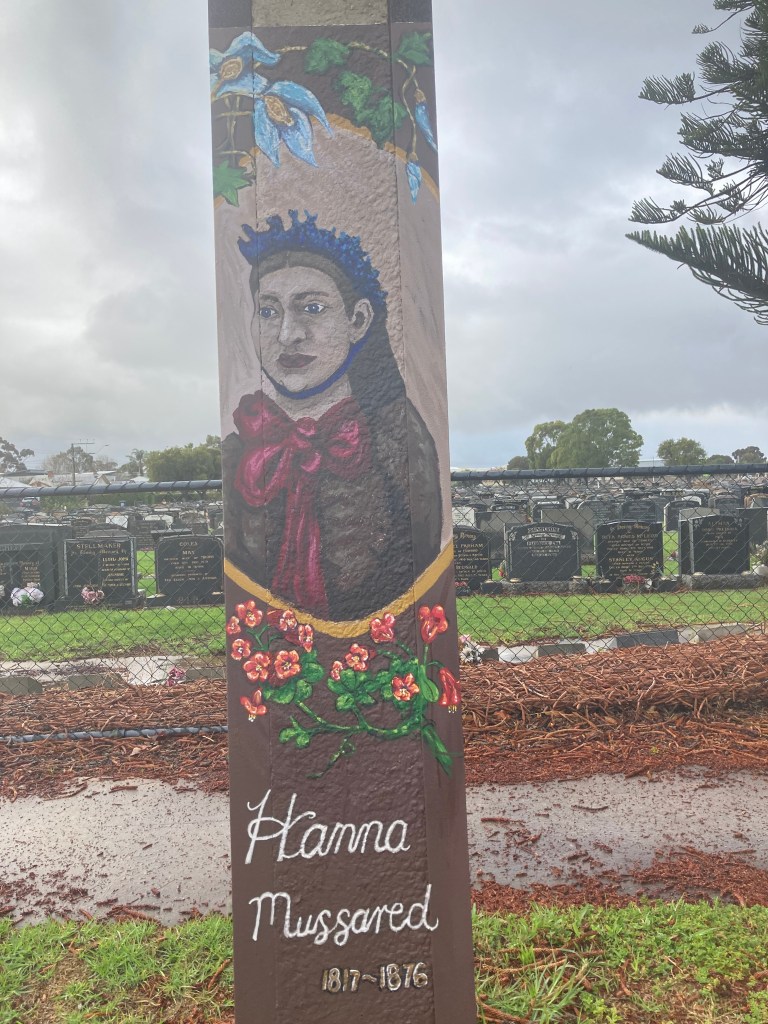
- The first recorded burial at The Cheltenham Cemetery was Mrs. Hanna Mussared, mother of five, on 27 Jul 1876, aged 58.
- Without an image of Hanna to base her artwork on, Tracey was influenced by the old photographs in artist Peter Drew’s work and took floral symbolic imagery from books about Victorian decorative design.
Grave Location: Section A. Drive B. Path 6
27. David Bower by Chloe Bower
Pole Location: Cnr High St & Woodstock St, south facing.
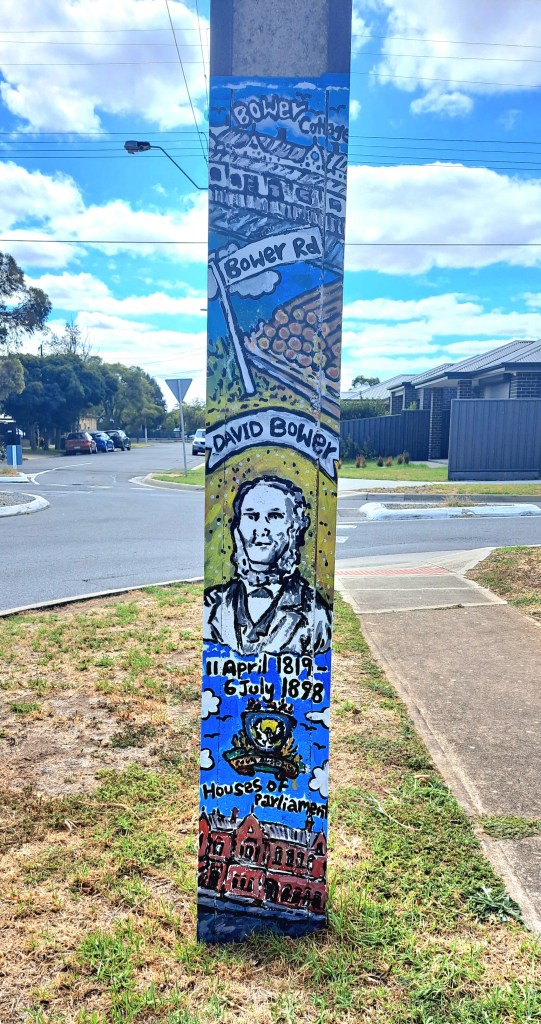
- Born 11 April 1819, Died 6 July 1898
- A South Australian colonial timber merchant, and politician.
- On 1 March 1865 he was elected to the South Australian House of Assembly as member for Port Adelaide, a seat he held until 4 April 1870.
- 1875 re-elected to Port Adelaide seat, which he represented until 18 March 1887.
- He was Commissioner of Public Works in the John Cox Bray Ministry from April to June 1884.
- Served as Mayor of Pt Adelaide twice.
Pictures available of his grave but location no longer recorded online
28. Ruby Hammond by Penny Mortimer
Pole Location: Cnr High St & Woodstock St, north facing.
- Born 10 March 1936, Died 16 June 1993
- Born in Kingston District Council.
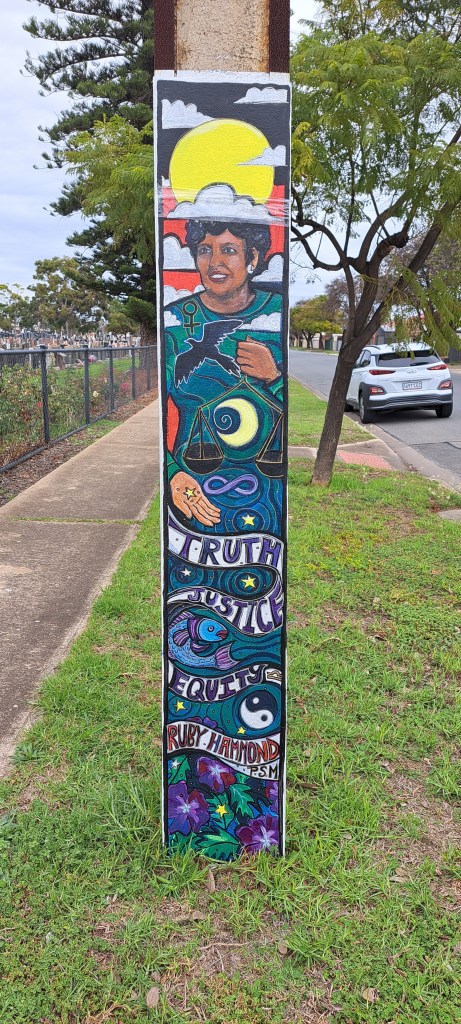
- An SA Aboriginal activist & public servant who fought for the needs & rights of urban Aboriginal people.
- Director of the Aboriginal Legal Rights Movement.
- Named South Australian Woman of the Year (1977).
- First Aboriginal person to receive the Australian Public Service medal (1993).
- Equal opportunity achievement award (1993).
- Published a biography through Wakefield Press: Flight of an Eagle: the dreaming of Ruby Hammond.
Grave Location: Rose Bush, Row PR, Site 8A
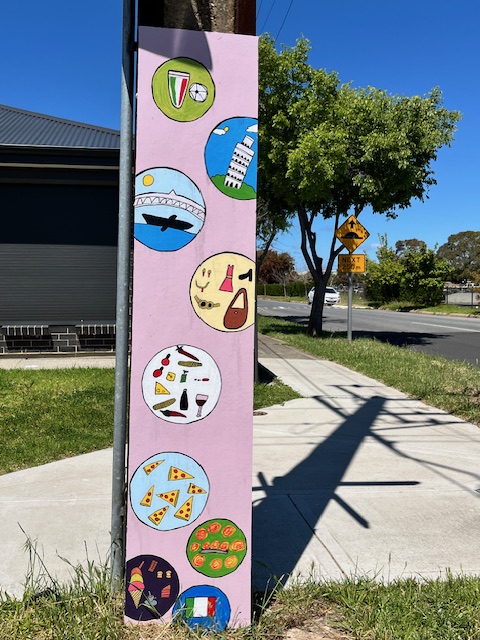
29. Italian Heritage by Rocquelle Larizza, Tutti Arts
Pole Location: Cnr High & Woodstock St, north of roundabout.
Rocquelle chose to honour her Italian grandparents who are buried at Cheltenham Cemetery.
30. In progress
Pole Location: Cnr High & Woodstock St, north of roundabout.

31. In progress
Pole Location: 3 Woodstock St, west facing.
32. In progress
Pole Location: 3 Woodstock St, east facing.
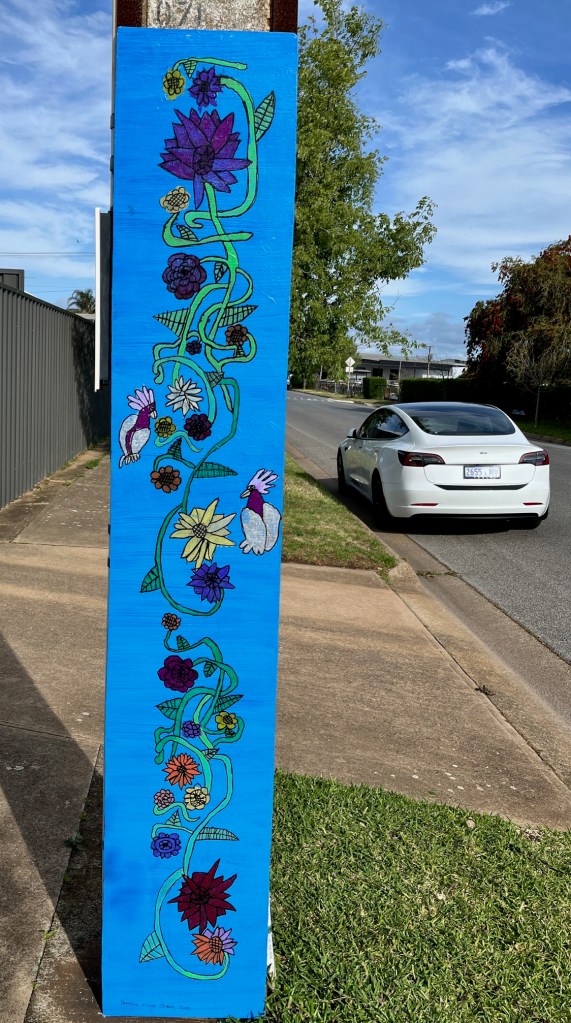
33. Bird life and Flora at Cemetery by Dannielle Zozuk, Tutti Arts
Pole Location: 7 Woodstock St, west facing.
Dannielle has chosen to depict the bird life and flora around the cemetery.
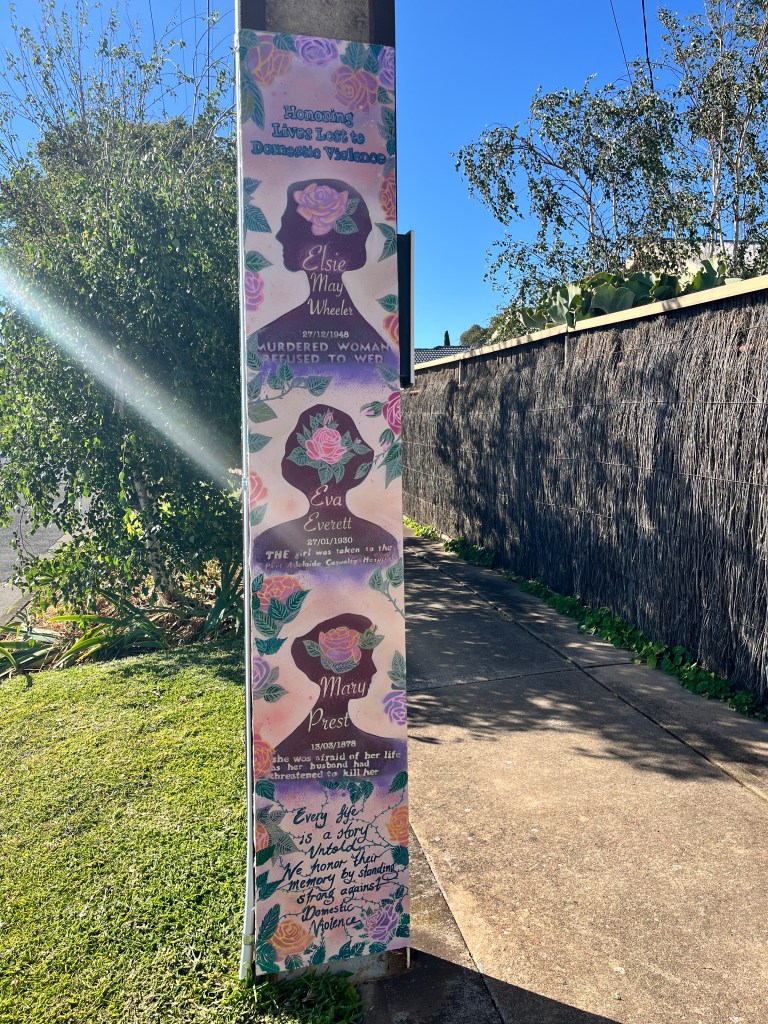
34. Honouring Lives Lost to Domestic Violence by Patricia Wozniak
Pole Location: 7 Woodstock St, east facing.
Honours the lives of three victims of domestic violence who were buried at Cheltenham Cemetery.
Elsie May Wheeler
Died 27th December 1949
Aged 42, Elsie’s throat was cut in Hutt Street, Adelaide, by her former partner, Albert Coates Griffin.
Eva Everett
Died 27th January 1930
Aged 22, was murdered by Jack Hearst. Jack then suicided.
Mary Prest
Died 13th March 1878
Aged 45, Mary was murdered at the Portland Estate by her husband, Jonathon Prest.
Grave Locations:
Elsie Wheeler: Section E, Drive B, Path 11 (33), Site No. 370C
Eva Everett: Section N, Drive C, Path 11 (33), Site No. 407S
Mary Prest: Section A, Drive B, Path 8 (9), Site No. 247S
35. In progress
Pole Location: cnr Woodstock St & Etna Ave, west facing.
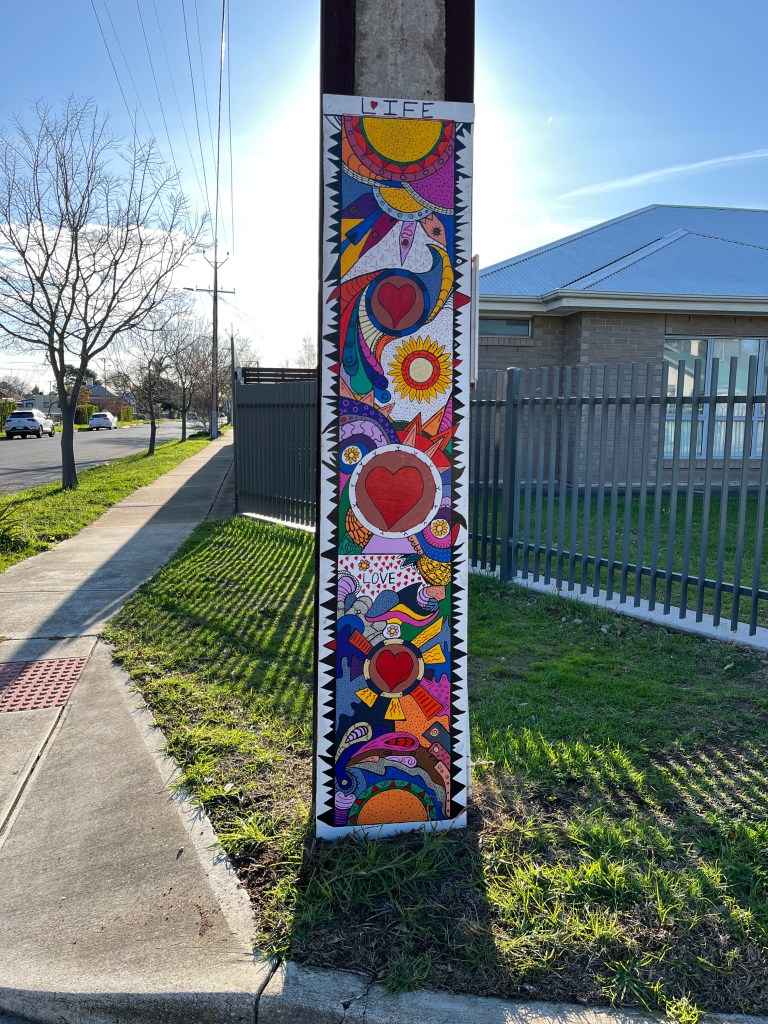
36. Grief, loss and love by Peter Grigoriadis
Pole Location: cnr Woodstock St & Etna Ave, east facing.
Peter’s artwork is a representation of the themes of grief, loss, love and care, all of which are very pertinent to our central theme of Cheltenham Cemetery.
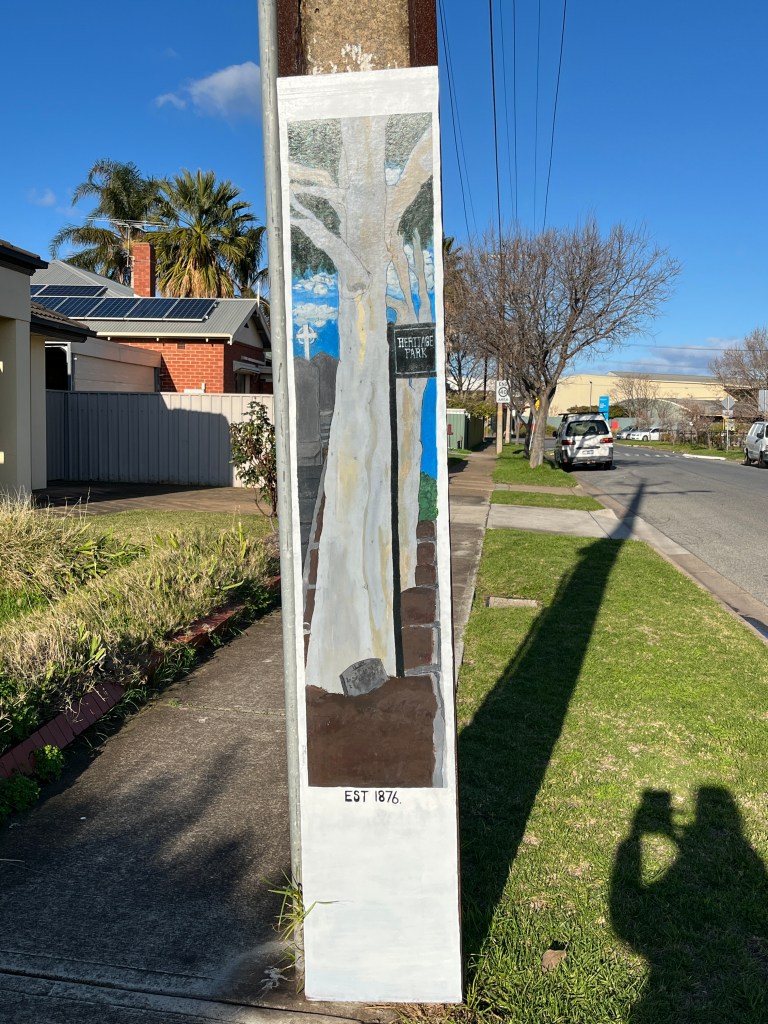
37. Image of the cemetery by Daniel Rossi
Pole Location: 7a Woodstock Street, west facing.
This is Daniel’s depiction of what you see if you turn to look at the cemetery from the vantage point of this pole’s location.
38. In progress
Pole Location: 7a Woodstock Street, east facing.
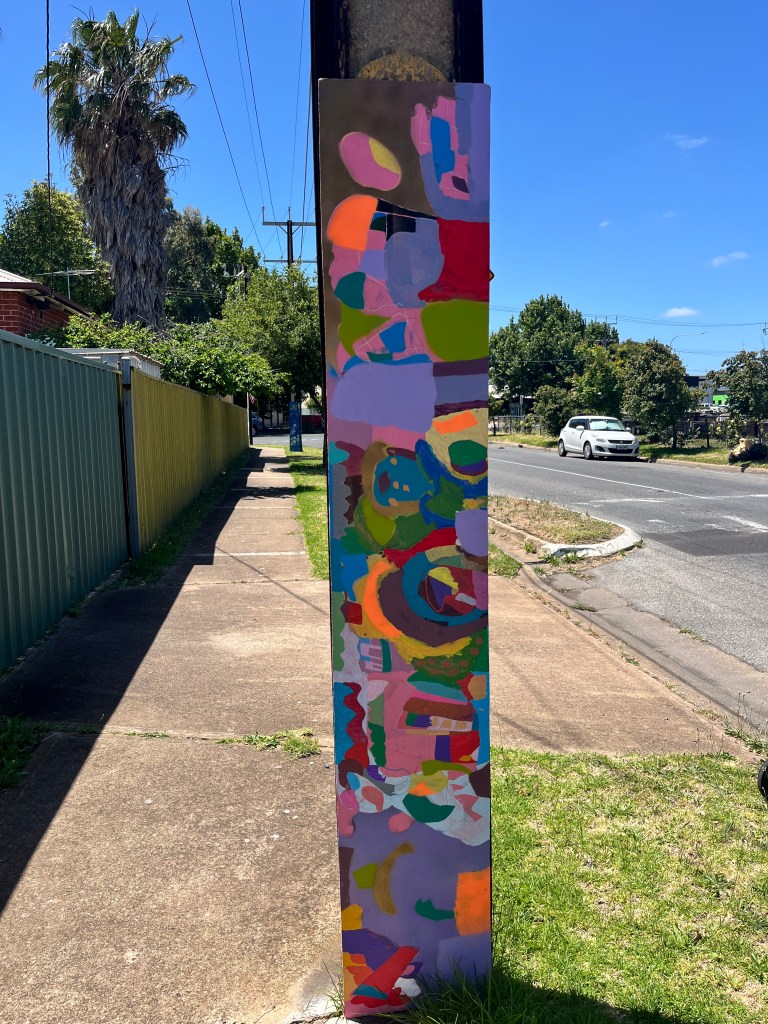
39. Abstract piece by Jasmine Jones, Tutti Arts.
Pole Location: 11 Woodstock Street, west facing.
40. In progress
Pole Location: 11 Woodstock Street, east facing.
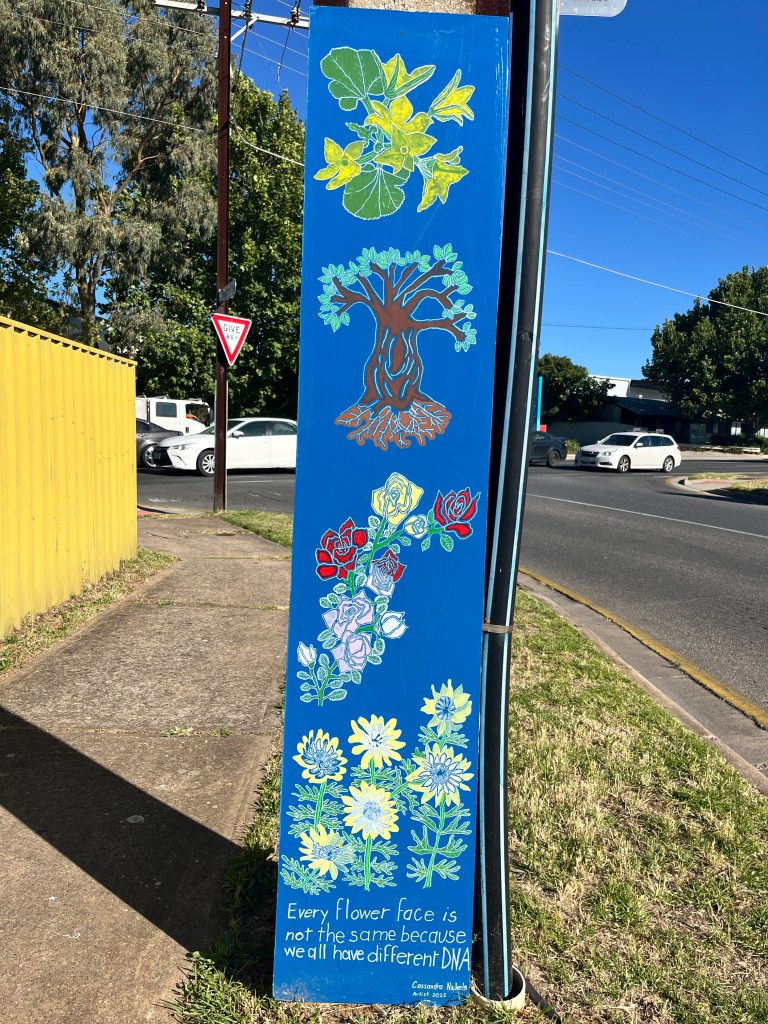
41. We are all unique by Cassandra Nickels, Tutti Arts.
Pole Location: Between 11 Woodstock St & Cheltenham Pde, west facing.
“Every flower face is not the same because we all have different DNA.”
This piece celebrates the diversity in Charles Sturt Council, and represented in Cheltenham Cemetery.
42. In progress
Pole Location: Between 11 Woodstock St & Cheltenham Pde, east facing.
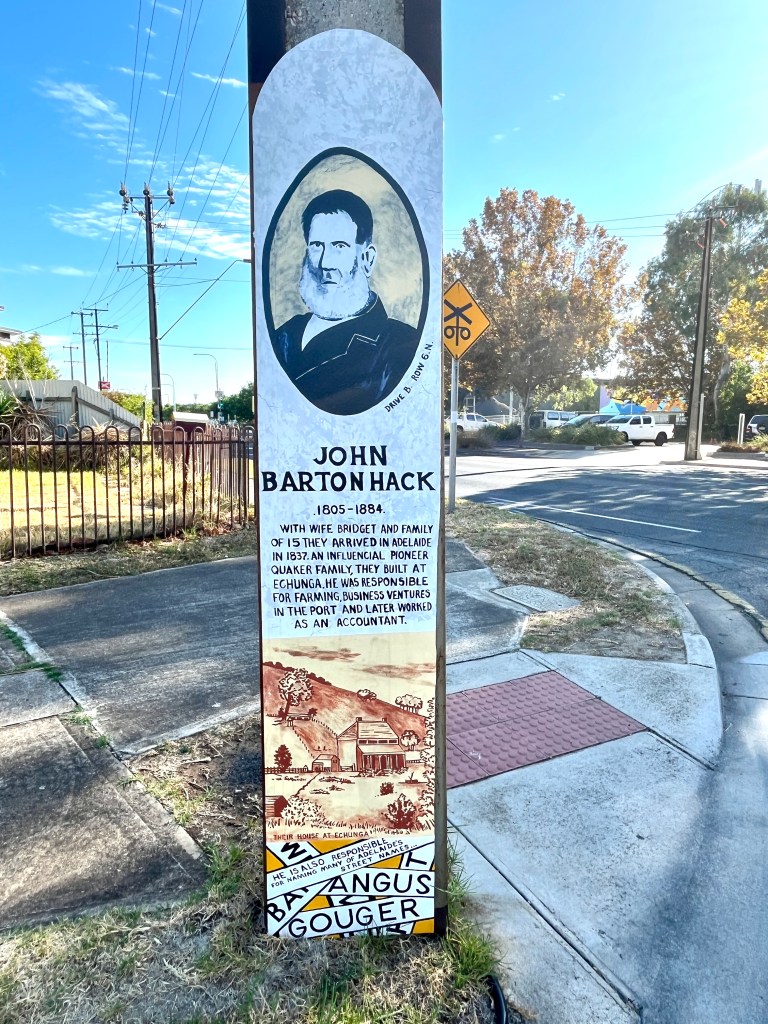
43. John Barton Hack by John Whitney
Pole Location: Cnr Woodstock St & Cheltenham Pde, south facing.
- 2 July 1805 – born in England.
- February 1837 – arrived in Holdfast Bay with his wife Bridget, their first six children, and his younger brother. He was seeking a warmer climate than England after illness damaged his lungs.
- He made good money with his bullock wagon, produce garden, dairy & an import business.
- March 1837 – he bought 24 hectares of land in Adelaide.
- H served on a committee for naming Adelaide’s streets, and won a Government tender for cutting the channel in the original Port Adelaide.
- Suffered losses of livestock that died while being shipped from Launceston.
- 1838 – bought Blenkinsop’s Whaling Station at Encounter Bay.
- 1839 – bought 4,000 acres at Echunga Springs, selling some land parcels, leasing others out, and setting up his farm.
- 1841 – in the depression he lost both the Whaling Station and Echunga Springs.
Later ventures were unsuccessful, including carting ore from Burra mines to Pt Adelaide, and a timber business. - 1851 – he tried his luck in the Victorian goldfields, returned with ‘modest wealth’, then lost it in dairy farming in the Coorong.
1863 – ill health forced him back to Adelaide. - 1870 – worked as a general accountant for the railways, then controller of railway accounts in 1870.
- 1883 – resigned from his job.
- 4 October 1884 – he passed away.
- He and his wife had a total of eight sons and three daughters.
He was known for being soft-hearted, paid his workers high wages, gave generous credit, to his own detriment.
He befriended First Nations people, ex-convicts, advocated for temperance, and donated land in Pennington Terrace for a Friends of the Quakers meeting house.
Grave Location: Section A, Drive B, Path 5(6), Site 8
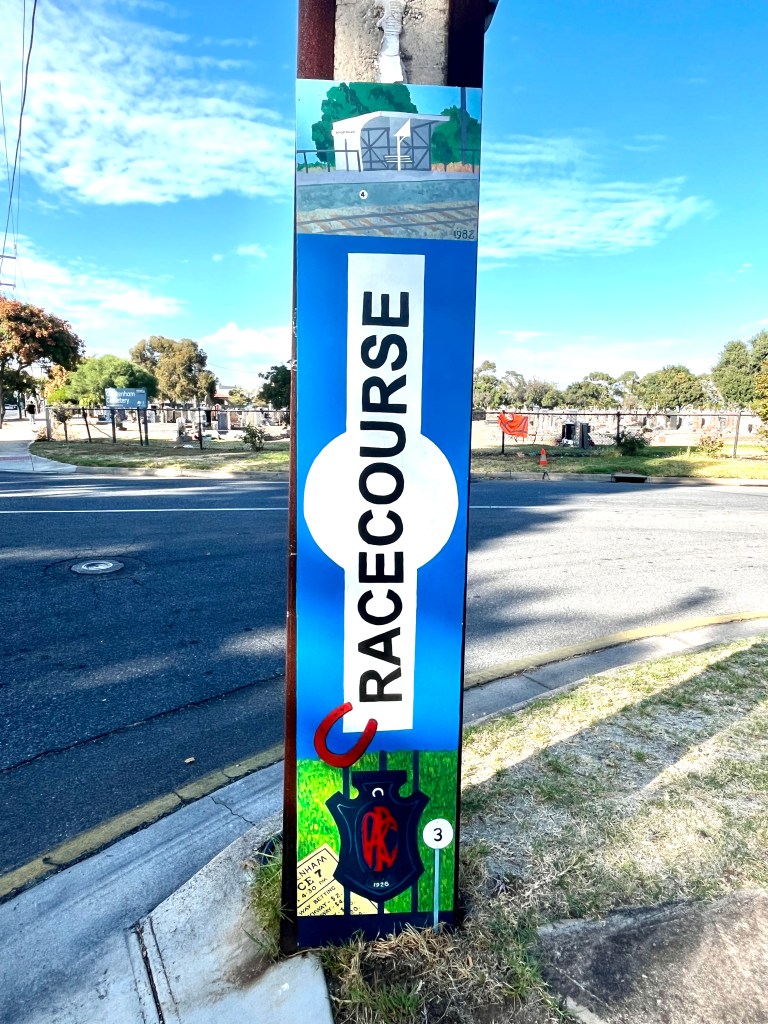
44. Racecourse by John Whitney
Pole Location: Cnr Woodstock St & Cheltenham Pde, north facing.
A tribute to the Cheltenham Park Racecourse, which opened in 1895 and closed in 2009. The top of the artwork depicts the old Cheltenham Racecourse train station.
45. In progress
Pole Location: Cheltenham Pde, north facing.
46. In progress
Pole Location: Cheltenham Pde, south facing.
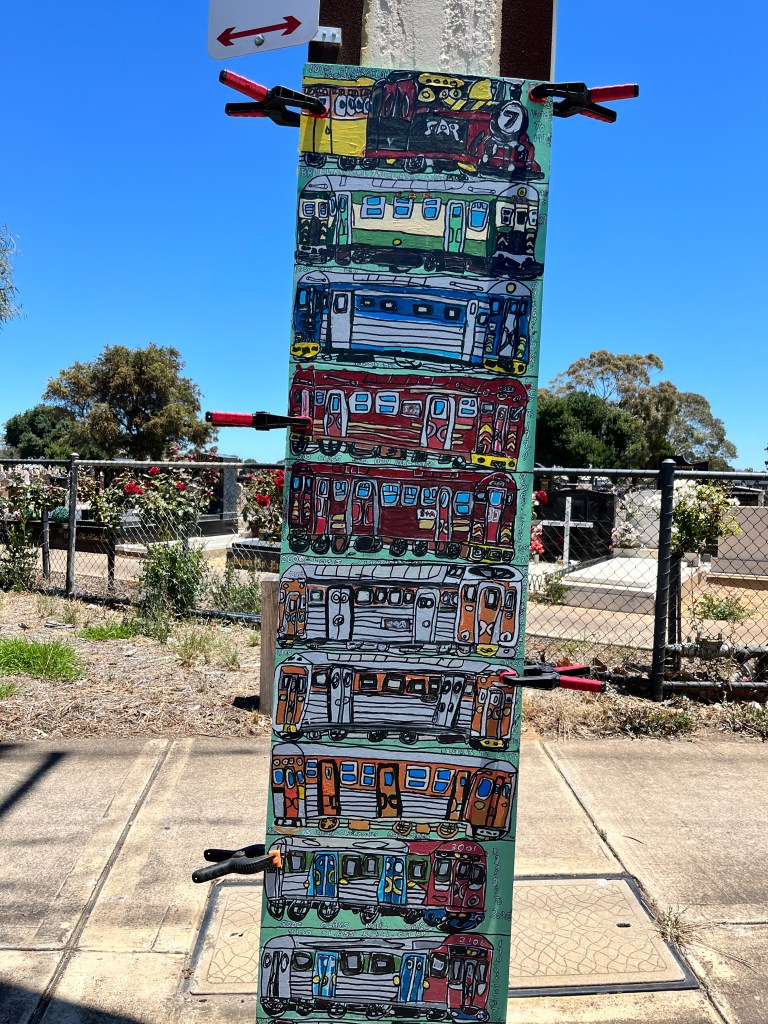
47. Adelaide trains through the decades by Scott Pyle, Tutti Arts.
Pole Location: Cheltenham Pde, east facing.
To link in with the train line that runs close beside the cemetery, Scott has created a piece depicting various models of trains.
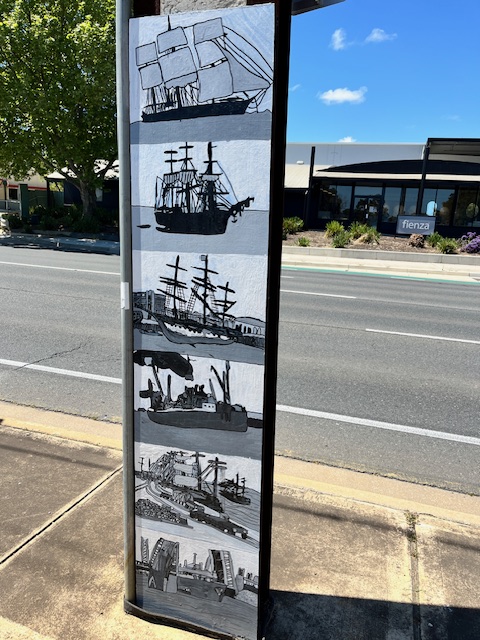
48.Port Adelaide Dockyards by Josh Maloney, Tutti Arts.
Pole Location: Cheltenham Pde, west facing. Across the road from Fienza.
Josh’s artwork shows the Port Adelaide Dockyards, and a range of ships, and the Birkenhead Bridge. It honours those who worked in connection with the shipping industry, who are buried at Cheltenham Cemetery.
49. In progress
Pole Location: Chippenham St, south of Drive D, north facing.
50. In progress
Pole Location: Chippenham St, south of Drive D, south facing.
51. In progress
Pole Location: Chippenham St, between Drive D & C, north facing.
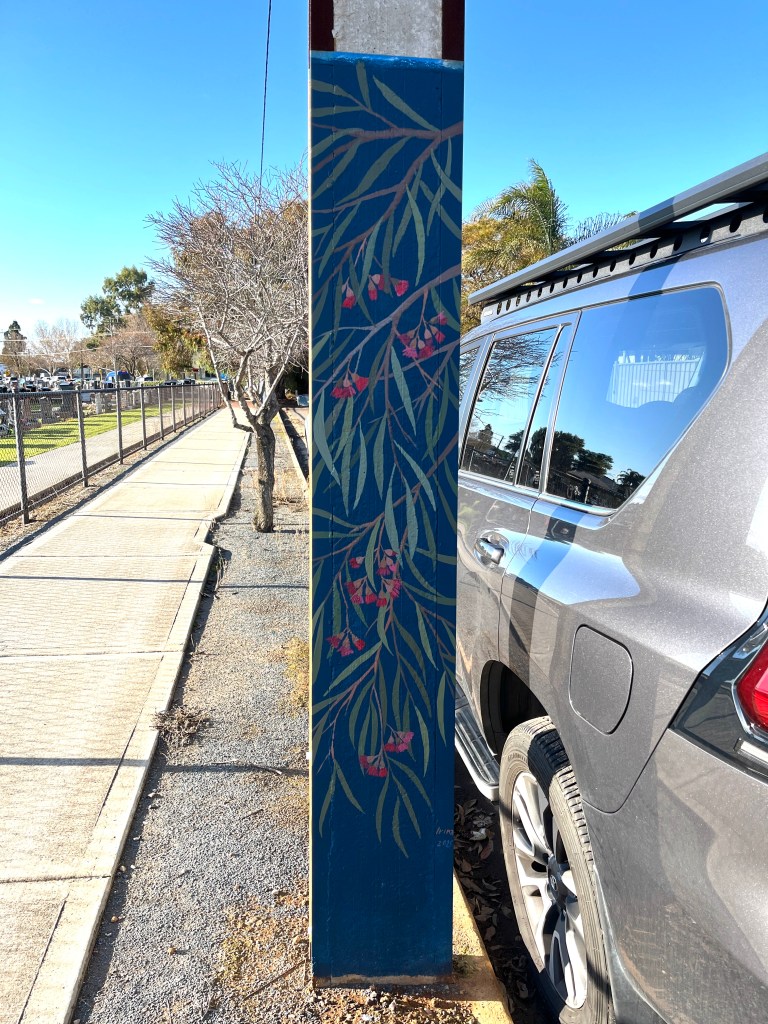
52. Flora of the area by Irina Nazarova
Pole Location: Chippenham St, between Drive D & C, south facing.
Irina has created this piece, depicting gum leaves and flowers, to reflect the flora of the area around the cemetery.
53. In progress
Pole Location: Chippenham St, at Drive C, north facing.
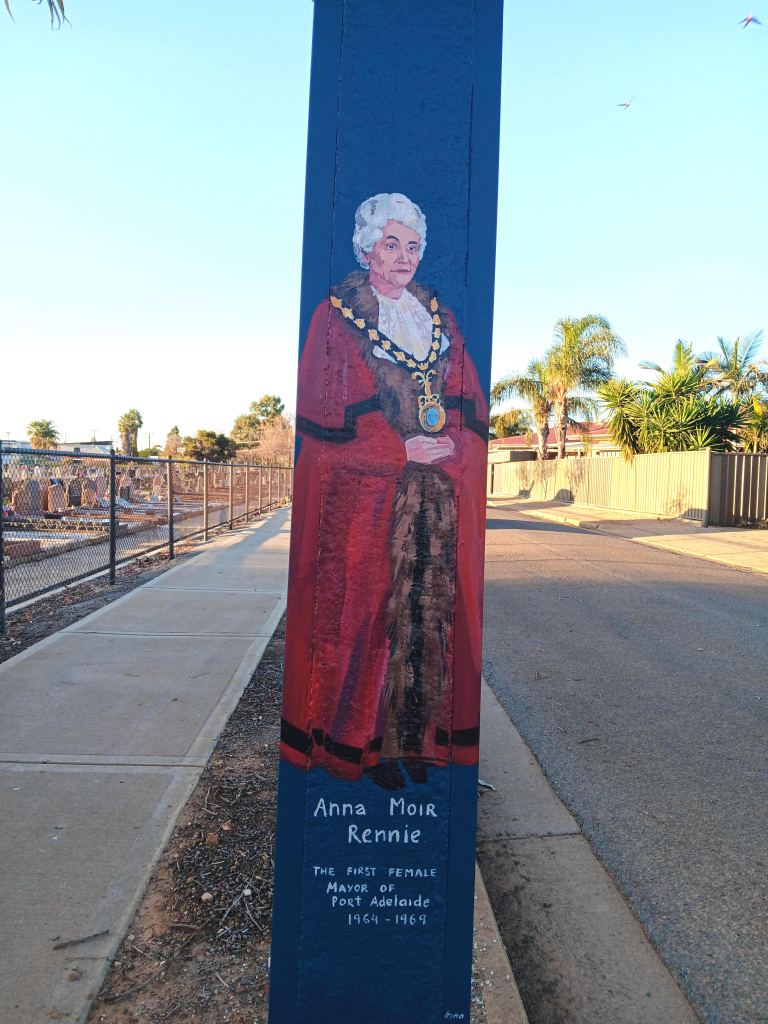
54. Anna Moir Rennie by Irina Nazarova
Pole Location: Chippenham St, at Drive C, south facing.
- Born 12 July 1899, Died 30 June 1987
- 1936 – she was hit by a truck on North Terrace. Told she would never walk again, her family assisted her rehabilitation with a stationary bike. She did walk again, with the aid of a support for her spine.
- Anna was the first female Council member of Port Adelaide’s South Ward in 1950.
- 1964-1969 she became the second female Mayor in South Australia, and first female Mayor in the metropolitan area, with Port Adelaide Council.
- She was an active member of the Australian Labor Party for 65 years.
- There is a plaque in her memory at the A.M. Reserve, North Haven.
- More information on Anna can be found here
Grave Location: Section HX, Drive B, Path 36, Site 12N
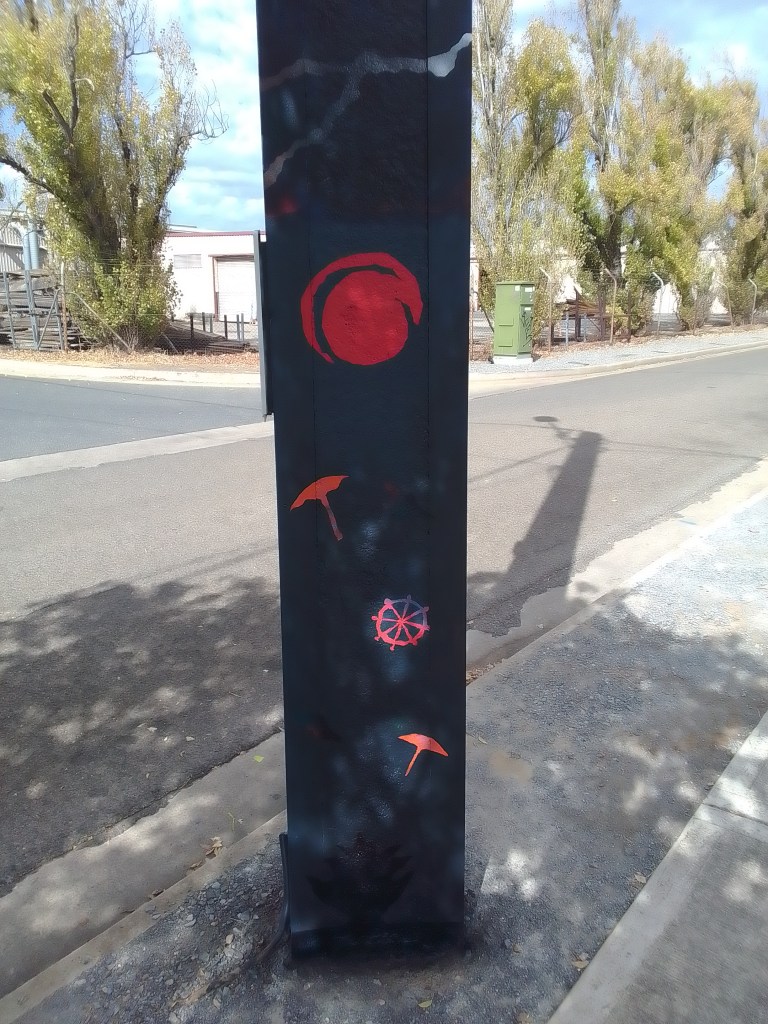
55. Japanese sailors tribute 1 by Elijah Vartto
Pole Location: Chippenham St opposite Wotton St, north facing.
This Japanese Buddhist symbology depicts an Umbrella, circle with eight divisions, and the darkened lotus.
The red circle references the Shinto circle, with the circle being made in one continuous stroke, which the artist sees as a parallel to imperfections of form, as it is in the world and life, yet still retaining beauty.
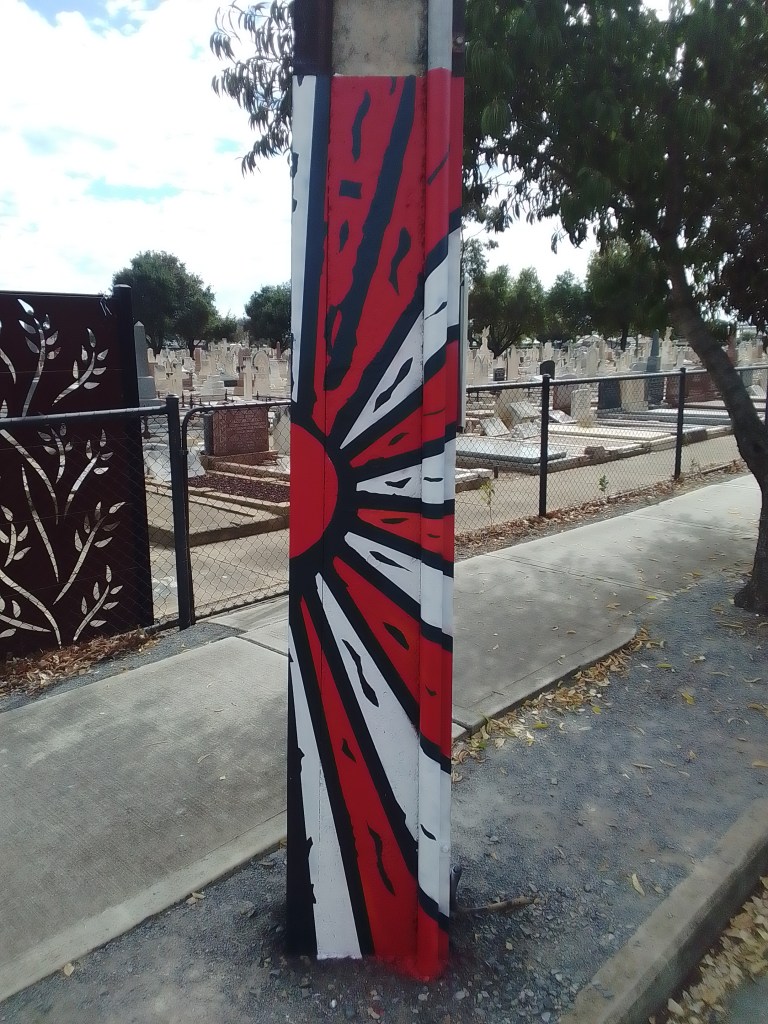
56. Japanese sailors tribute 2 by Elijah Vartto
Pole Location: Chippenham St opposite Wotton St, south facing.
In honor of the Japanese sailors buried at Cheltenham Cemetery:
Yoshikuma Kawakami, died 1887
- Yoshikuma, 20 yr old naval cadet, died at sea of a lung infection whilst on Japanese warship, The Ryujo. Buddhist tradition does not allow sea burials so his body was brought to Adelaide.
Chuhichi Ikeyama, died March 1929 and Toraichi Shirahama, died March 1929
Chuhichi and Toraichi were Japanese merchant seamen, both killed in an accident at Port Adelaide in March 1929. Were working on the Kyokkoh Maru’s boiler when they were badly scalded by steam escaping. Both died from their injuries.
The artwork is an artistic representation of the Japanese rising sun, with addition of navy blue. One shard of red has a depiction of the military sword buried with the naval officers.
Grave Locations:
Yoshikuma Kawakami: Section H. Drive B. Path 41.
Chuhichi and Toraichi: Site 59 Section B. Drive A. Path 6(7). Site Number 171N
57. In progress
Pole Location: Chippenham St, south of Drive B, West facing.
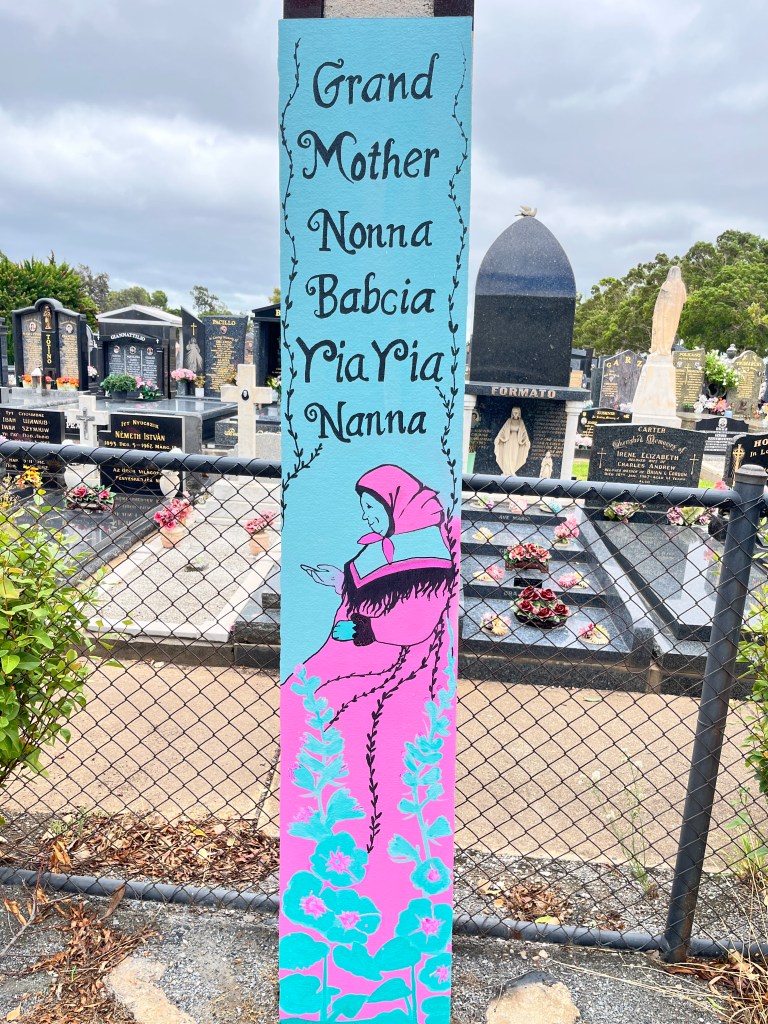
58. Grandmothers by Patricia Wozniak
Pole Location: Chippenham St, south of Drive B, East facing.
This piece honours all Grandmothers, living and deceased. The inclusion of the word Grandmother in different languages recognises the diverse cultures represented in the cemetery, and living in the Charles Sturt Council.
59. In progress
Pole Location: Chippenham St, south of Drive A, West facing.
60. In progress
Pole Location: Chippenham St, south of Drive A, East facing.
61. In progress
Pole Location: Cnr Chippenham St & Port Rd, north facing.
62. In progress
Pole Location: Cnr Chippenham St & Port Rd, south facing.
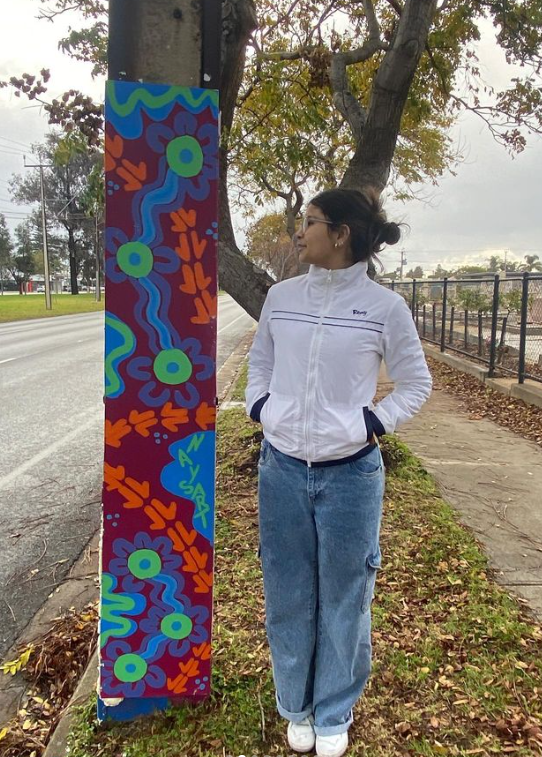
63. Home away from home by Tanaya Anthony
Pole Location: Port Rd, west of bus stop 25, east facing.
“This story is inspired by my mob’s land, Narungga (Yorke Peninsula ways).
The emu footprints are to represent the well-known animal of that area and also as one of the totems.
The waterways and land marks are marking the beautiful water and beaches and the country of Narungga, as when I’m home on country my favourite part is the fishing and beaches.”
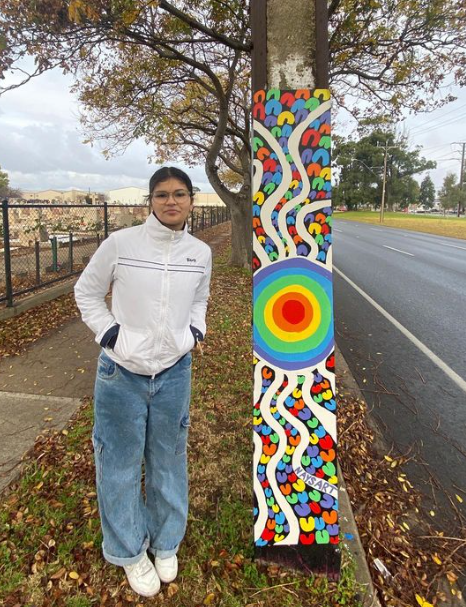
64. There’s pride in everyone by Tanaya Anthony
Pole Location: Port Rd, west of bus stop 25, west facing.
Dedicated to everyone in the LGBT community and allies, to express that you are loved, important and seen.
The stories in the artwork illustrate people surrounding a campsite in the LGBT flag colours
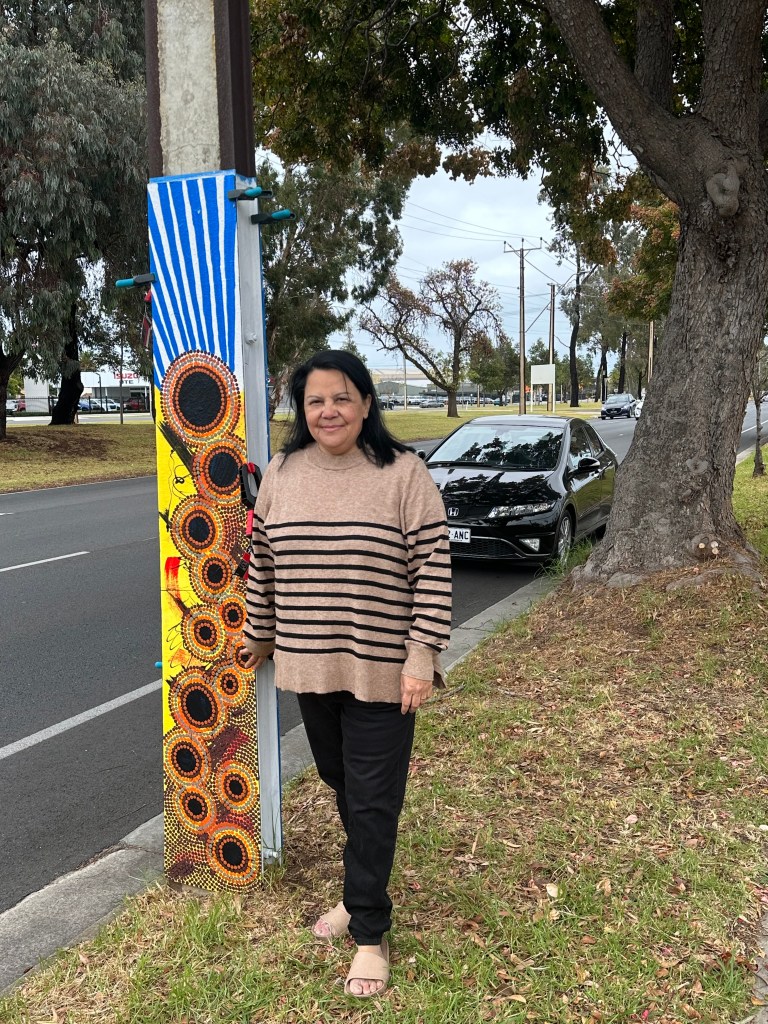
65. My community together at the cemetery by Robyn Branson-Rigney
Pole Location: Port Rd, west of bus stop 25, east facing.
- This painting represents the community coming to visit their loved ones at the cemetery.
- Our community come from all over metropolitan areas, from the sea, rivers and along the desert to show their respect for families.
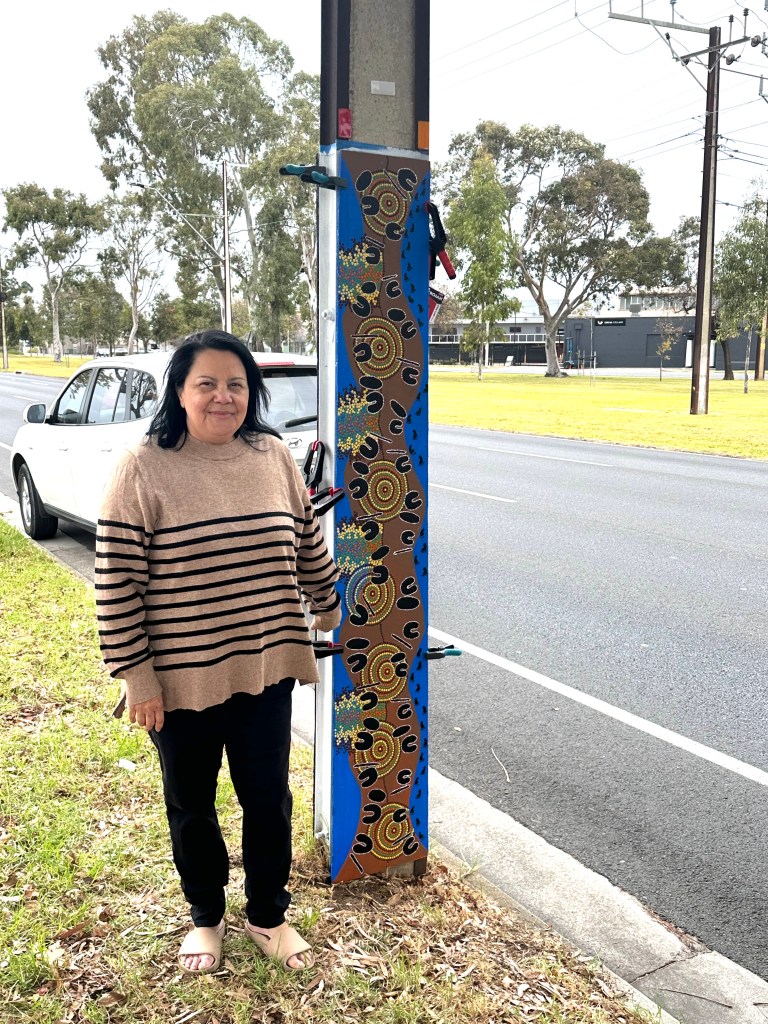
66. Honouring my family by Robyn Branson-Rigney
Pole Location: Port Rd, west of bus stop 25, west facing.
- With this painting I have honoured my Father, David Branson, as he is buried here at Cheltenham Cemetery, along with my great Aunty Josie and Uncle Ray (Stink).
- This is my version of my family, that are buried at Cheltenham Cemetery, on their way home to heaven. This includes my Dad, Aunty Josie & Uncle Ray (stink) and other family members that are making the journey home.
David Allen Branson, Born 18 March 1952, Died 31 Oct 2019.
Grave location: Section L. Drive C. Path 13. Site 58C.
